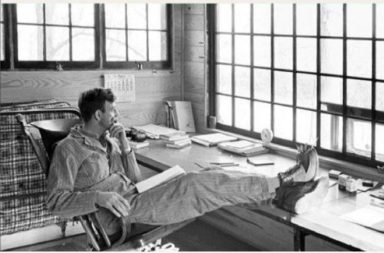
Exploring contemplative awareness in daily life, drawing from and with much discussion of the writings of Thomas Merton, aka "Father Louie".
Tuesday, May 7, 2019
Enfolded in weakness and hope
“When you die, you fall asleep. And you wake up, and there’s a very gentle peace. You feel well. And then you discover the face of God coming through that ‘wellness’. "
- Speaking to the Tablet in 2017
“But let us not put our sights too high. We do not have to be saviours of the world! We are simply human beings, enfolded in weakness and in hope, called together to change our world one heart at a time.”
- Becoming Human
More Quotes from Jean Vanier are HERE.
Jean Vanier died early this morning, just outside of Paris. RIP.
Friday, May 3, 2019
There is no going back
No, no, there is no going back.
Less and less you are
that possibility you were.
More and more you have become
those lives and deaths
that have belonged to you.
You have become a sort of grave
containing much that was
and is no more in time, beloved
then, now, and always.
And so you have become a sort of tree
standing over a grave.
Now more than ever you can be
generous toward each day
that comes, young, to disappear
forever, and yet remain
unaging in the mind.
Every day you have less reason
not to give yourself away.
Less and less you are
that possibility you were.
More and more you have become
those lives and deaths
that have belonged to you.
You have become a sort of grave
containing much that was
and is no more in time, beloved
then, now, and always.
And so you have become a sort of tree
standing over a grave.
Now more than ever you can be
generous toward each day
that comes, young, to disappear
forever, and yet remain
unaging in the mind.
Every day you have less reason
not to give yourself away.
~ Wendell Berry ~
Thursday, April 25, 2019
The Wisdom of Tenderness
“In this communion, we discover the deepest part of our being: the need
to be loved and to have someone who trusts and appreciates us and who
cares least of all about our capacity to work or to be clever and
interesting.”
Friday, April 19, 2019
the poor and rejected, the hungry, the naked, the incarcerated, the outcast
From the homily of Capuchin Father Raniero Cantalamessa, Preacher to the Pontifical Household, for the Solemn Liturgy of the Passion of the Lord, in St Peter's Basilica on Good Friday afternoon, 2019:
"The African-American writer and theologian Howard Thurman—the man Martin Luther King considered his teacher and his inspiration for the non-violent struggle for human rights—wrote a book called Jesus and the Disinherited.”[1] In it he shows what the figure of Jesus represented for the slaves in the south, of whom he himself was a direct descendant. When the slaves were deprived of every right and completely abject, the words of the Gospel that the minister would repeat in their segregated worship —the only meeting they were allowed to have— would give the slaves back a sense of their dignity as children of God.
"The majority of Negro Spirituals that still move the world today arose in this context. At the time of public auction, slaves experienced the anguish of seeing wives separated from their husbands and children from their parents, being sold at times to different masters. It is easy to imagine the spirit with which they sang out in the sun or inside their huts, “Nobody knows the trouble I have seen. Nobody knows, but Jesus.”The text of the entire homily is HERE.
Living in the Light of Death
![]() |
| Via Crucis, Good Friday 2014, Colisseum Roma Italia photo by Beth Cioffoletti |
As St. Augustine taught, we must “die daily” to our small and separate sense of self. Kathleen Dowling Singh offers an invitation to practice dying through meditation. In her words, “We can sit to meditate with the intention to let it all go, inspired to explore what lies beyond self.”
“We sit deliberately, with noble posture and noble attention.
“We breathe. Progressively, we free our awareness from sensations. We free our awareness from the ‘I’ we imputed upon the sensations and the ‘mine’ with which we tried to claim them. We relieve ourselves of all of our mistaken identifications, loosening our attachments to them, letting them go.
“We liberate ourselves from illusions and, cleared of all that congested weight, the burden of being a self, we surrender, entering awareness that is spacious and quiet and uncongested.
“We just die into silence. Die to the past. Die to the future. Die to the breath. Completely let go. The silence reveals itself as refuge, as awareness that can be trusted, tenderly loving and resounding with the majesty and the mystery of the sacred.”
Adapted from “Living in the Light of Death” by Kathleen Dowling Singh,
Oneing, “Ripening,” Vol. 1 No. 2, pp. 42-44
[repeat post from Good Friday, 2014]
Tuesday, April 9, 2019
This is the end, for me the beginning of life
On April 9, 1945, after conducting a prayer service for fellow prisoners in Flossenberg camp, #DietrichBonhoeffer received a summons: “Prisoner Bonhoeffer, get ready and come with us.” He replied, "This is the end, for me the beginning of life.” He was hanged that night.
The path to his death at 39 was prefigured in his early work on "The Cost of Discipleship," where he wrote that the Cross "meets us at the beginning of our communion with Christ. When Christ calls a man, he bids him come and die.”
This end was also prefigured in his early recognition of the idolatrous and evil designs of Hitler's Third Reich. He helped form the Confessing Church to resist Hitler's efforts to co-opt Christianity in favor of a national cult of "German Christianity."
Eventually he accepted a safe haven in New York's
Back in Germany he joined a secret conspiracy to overthrow Hitler: “The church’s task is not simply to bind the wounds of the victims beneath the wheel, but also to put a spoke in the wheel itself.”
Although this violated his pacifist leanings, he came to believe: “The ultimate question for a responsible man to ask is not how he is to extricate himself heroically from the affair, but how the coming generation is to live.” With his fellow conspirators he was arrested in 1943.
In prison he imagined a new perspective for the church—not from the center of power and status, but from “below, from the perspective of the outcast, the suspects, the maltreated, the powerless, the oppressed, the reviled—in short, from the perspective of those who suffer.”
Bonhoeffer is the rare theologian whose biography is studied as carefully as his written work for clues about the challenge of faith in our time--in particular, the ethical dilemmas of responsible action in the face of injustice and tyranny.
He represents a model of holiness: not in the cloister, or in some safe "religious" zone, but in the midst of history, in discernment, in judging how God is calling us to respond to the needs of our suffering neighbors. A witness for our time.
- from a thread of tweets by Robert Ellsburg on Twitter.
https://twitter.com/RobertEllsberg/status/1115640930369966085
"There is no way to peace along the way of safety. For peace must be dared, it is itself the great venture and can never be safe. Peace is the opposite of security. To demand guarantees is to want to protect oneself. Peace means giving oneself completely to God's commandment, wanting no security, but in faith and obedience laying the destiny of the nations in the hand of Almighty God, not trying to direct it for selfish purposes. Battles are won, not with weapons, but with God. They are won when the way leads to the cross." - Dietrich Bonhoeffer
Saturday, March 2, 2019
Trust Your Inner Life
Brother Patrick Hart, O.S.C.O, died (Feb. 21) and was buried last week. Brother Patrick was appointed Merton's secretary just before he died, and guided the publications and voluminous correspondence surrounding Merton's work in the 50 years following his death.
Brother Patrick is said to have been a very kind man who did not engage in gossip.
From an article in the Angelus - https://angelusnews.com/news/robert-inchausti/remembering-brother-patrick-hart-the-monk-who-saw-all-sides-of-thomas-merton -
In a 2004 interview with Sister Mary Margaret (Meg) Funk OSB — then Executive Director of the North American Commission of Monastic Inter-religious Dialogue — asked Brother Patrick “a broad but basic question.”“In a nutshell, what do you think is Merton’s legacy for monasticism?”Brother Patrick answered: “Maybe, that you have to trust your inner life, your innermost self, as you appear before God. Merton was always very strong on this idea of living from the deepest self, the true self, rather than the empirical ego or the external self, the social self. This means that you live as you stand naked before God. I think that’s what he would say. He would tell us to listen from the heart and to live a simple, honest life, united to God and one another.” ...
In the sometimes topsy-turvy world of theological controversies and Merton scholarship, Brother Patrick Hart was a rock of clarity, compassion, and common sense — protecting Merton’s writings and the integrity of contemplative Catholicism from the would-be usurpers, slanderers, and uninformed. His was the delicate vocation of a literary apostle and humble monk. May he rest in peaceThank you, Brother Patrick.
Here are some other links on this blog about Brother Patrick:
Subscribe to:
Posts (Atom)
Pentecost
Kelly Latimore Icon "You have made us together, you have made us one and many, you have placed me here in the midst as witness, as aw...