Showing posts with label Misc Merton quotes. Show all posts

Thursday, April 21, 2022

A dreadful hatred of life


cover of the Manifesto pamphlet

On this Earth Day, I post a Merton writing that was never published in America, indeed not much known about. It appeared in a small pamphlet published in England in the summer of 1966.
A STATEMENT ON FACTORY FARMING:

Since factory farming exerts a violent and unnatural force upon the living organisms of animals and birds, in order to increase production and profits, and since it involves callous and cruel exploitation of life, with implicit contempt for nature and for life, I must join the protest which is being uttered against it. It does not seem that these methods have any really justifiable purpose except to increase the quantity of production at the expense of quality: if that can be called a justifiable purpose. However, this is only one aspect of a more general phenomenon: the increasingly destructive and irrational behaviour of technological man. Our society seems to be more and more oriented to overproduction, to waste, and finally to production for destruction. Its orientation to global war is the culminating absurdity of its inner logic, or lack of logic. The mistreatment of animals in “intensive husbandry” is the part of this larger picture of insensitivity to genuine values and indeed to humanity and to life itself – a picture which more and more comes to display the ugly lineaments of what can only be called by its right name: barbarism.

Monica Weiss SSJ, unearths the origins and context of this writing in an article in The Merton Seasonal HERE. Monica is the author of the forthcoming book, The Environmental Vision of Thomas Merton.

"Here once again, Thomas Merton is in the forefront of eco-justice, encouraging us to develop an ecological consciousness. How is it that Merton, with his propensity for contemplation and the hermit life, can envision the negative ramifications of apparently salvific and cutting-edge human activity? If ever we doubted that Merton was ahead of his time or supposed that he was prophetic only on the dangers of nuclear war, this issue of factory farming should dispel any doubt." - Monica Weiss SSJ

Friday, December 31, 2021

He wanted to drift on the river …

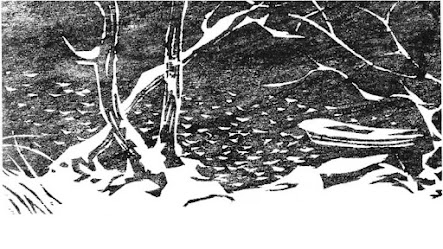
Harlan Hubbard Woodcut, “Lee’s Landing in the Snow”, Xmas Card 1953

He wanted to drift on the river not so much to see where it went
as to be one with it, to go with it as virtually a part of it.
He wished perhaps to live out a kind of parable.
One cannot drift by intention –
or at least, in intending to drift and in drifting,
one must accept a severe limitation upon one’s intentions.
But in giving oneself to the currents,
in thus subordinating one’s intentions,
one becomes eligible for unintended goods,
unwished-for gifts –
and often these goods and gifts surpass
those that one has intended or wished for.
And so a drifter subscribes necessarily to a kind of faith
that is identical both to the absolute trust of migrating birds
and to the scripture that bids us to lose our lives in order to find them.
Harlan stated it in 1932 with characteristic simplicity:
“I believe that whatever we need is at hand.” 

– Wendell Berry, from Harlan Hubbard – Life and Work

___

The apocalyptic word is “Come!” 

The Spirit and the bride say, “Come!” And let him who hears say, “Come!” Whoever is thirsty, let him come; and whoever wishes, let him take the free gift of the water of life."


REVELATION 22:17 (NIV)


I come into solitude to die and love. I come here to be created by the Spirit in Christ. I am called here to grow. "Death" is a critical point of growth, or transition to a new mode of being; to a maturity and fruitfulness that I do not know (they are in Christ and in His Kingdom). The child in the womb does not know what will come after birth. He must be born in order to live. I am here to face death as my birth.


This solitude-a refuge under His wings, a place to hide myself in His Name, therefore, a sanctuary where the grace of Baptism remains a conscious, living, active reality valid not only for me but for the whole Church. Here, planted as a seed in the cosmos, I will be a Christ seed, and bring fruit for other men. Death and rising in Christ.


Thomas Merton. Dancing in the Water of Life. Journals, Volume 5. Robert E. Daggy, editor. San Francisco: HarperSanFrancisco, 1997: 333-334.

I need to be "confirmed" in my vocation by the Spirit... This ordains me to be the person I am and to have the particular place and function I have, to be myself in the sense of choosing to tend toward what God wants me to be, and to orient my whole life to being the person He loves.

Dancing in the Water of Life: 334


___ 

Sunday, February 7, 2021

the radiation of a silence that is filled with love

Merton’s essay, “Day of A Stranger” for Ludovico Silva’s magazine "Papeles" is among his best. His essay relates a “day” in Merton’s life at his hermitage. Merton writes in the unexpurgated voice of the self he was excavating to be most true. He speaks of who he has become through his unique monastic journey in three simple, declarative sentences:

What I wear is pants.
What I do is live.
How I pray is breathe.

Merton’s speech, for this one day at least, is terse and impoverished. He distills his voice down into its ordinary communion with all simple beings inhabiting the world:

“What I wear is pants.” (He puts off his monastic robes and the cowl that implicates his distinction and “specialness” from others. He knows himself only as he is, another ordinary man in blue jeans accomplishing ordinary tasks. He sweeps his porch; he tends his fire.)

“What I do is live.” (His vocation is a call to be simple. He needs no other place to go than where he is now. He has no one else to meet. He quiets his pronouncements. He surrenders, to this one day at least, all his grandiose plans. He considers the next task in front of his nose, even just chopping wood, as God’s will for him right now.)

“How I pray is breathe.” (Being grateful to be alive is prayer. Being awake and watching as day breaks, and staying up all night as the stars dance, is his contemplation. He forgets whatever he has written on prayer and prays. He listens to whatever voices in the trees or in the gardens of his mind call out for his attention. Silence harmonizes him; it renders him receptive to the ‘hidden wholeness’ of each thing with every other thing to which his heart connects. Alone in the woods, he listens to the speech rain makes. He plays his small part in the simple ecologies of another day. He realizes, for this one day at least, the way the wind is blowing. And thus he receives the fruits of a sermon by the birds living near his hermitage: they are inviting him to share their liberty, to know the ordinary freedom of those who do not know they have names.)
In a journal entry for July 25, 1963, Merton transcribed in English two notes from the French in an article by M. MorĂ© in the magazine "Dieu Vivant" (12). Merton could have written these words. The two insights he culled from this article are a gloss on the three simple declarations of his "true voice:" “What I wear is pants. What I do is live. How I pray is breathe”. Merton had underlined MorĂ©:

"We don’t ever stop being plagued by words: they devour us… We spend most of our lives editing pamphlets, manifestoes, reports, writing articles, essays, novels. We rush in crowds to conferences whose numbers grow each day in inverse proportion to the interest they hold."

Then, from further down in the article, Merton copied an even more significant insight:

"The witness required of each of us is much more that of a transparency rather than a witness of words—a word, even an exact one, can raise a lot of contradictions, but nothing can resist the radiation of a silence that is filled with love.”

The “radiation of a silence that is filled with love” encapsulates Merton’s hopes for himself as a monk and writer that his life could eventually become a more silent witness to Life's simple, underground inclusiveness, to the “hidden ground of love” that binds us all. (Jonathan Montaldo) 

Link to Merton's essay, "Day of a Stranger" is HERE.

Link to Jonathan Montaldo's "Uncaging His Own Voice" is HERE

Monday, December 28, 2020

those for whom there is no room

"Christ’s place is with those others for whom there is no room. 

His place is with those who do not belong, 

who are rejected by power, because they are regarded as weak, 

those who are discredited, 

who are denied the status of persons, tortured, exterminated. 

With those for whom there is no room, Christ is present in this world. 

He is mysteriously present in those for whom there seems to be nothing but the world at its worst…

It is in these that he hides himself, [the people] for whom there is no room.”

-- Thomas Merton
Raids on the Unspeakable (p 72-73)

Wednesday, October 28, 2020

a monstrous irrationality

"We are victims of a monstrous irrationality

- which we call 'means of communication' -

but which in actual fact obstructs real communication.

A vast machine which processes 'events' and reduces them to gibberish

in which reality is a total loss."

- Thomas Merton

Thursday, May 21, 2020

Thomas Merton, Essential Writings


From Jim Forest (on the little book, "Essential Writings"). I too, think that this collection of quotes are a pretty good synopsis of Merton's thought and spirit. I like the simple incisiveness of the quotes and the way in which they are compiled. Reminds me of why I always go back to Merton, again and again. Merton touches something in me that resonates, wakes me up some.

“The Christian must have the courage to follow Christ. The Christian who is risen in Christ must dare to be like Christ: he must dare to follow conscience even in unpopular causes. He must, if necessary, be able to disagree with the majority and make decisions that he knows to be according to the Gospel and teaching of Christ, even when others do not understand why he is acting this way… (p. 189).” 
 My first encounter with Merton was in 1969, when I was 19 years old investigating the pacifist roots of the Christian faith. I picked up Merton’s booklet entitled “Blessed Are the Meek: The Christian Roots of Nonviolence,” published by the Catholic Peace Fellowship. The entire contents of this booklet are included in these “Essential Writings.”) 
This volume is divided into three sections, in addition to the preface and a brief biography of Merton’s life: contemplation, compassion and unity. The selections are presented, more or less, in chronological order, giving the reader some insight into the development of his thinking over the years. I have a friend who says that Merton “went off the deep end” near the end of his life. But I dare say that my friend probably didn’t read what Merton wrote. This book assures me that Merton never strayed from the Christian tradition, even while trying to engage in dialogue with monks and mystics from other traditions.

Below are favorite quotes.

CONTEMPLATION

“For me to be a saint means to be myself. Therefore the problem of sanctity and salvation is in fact the problem of finding out who I am and of discovering my true self (p. 55).”

“Every moment and every event of every man’s life on earth plants something in his soul (p. 57).”

“There is another essential aspect of Christianity: the interior, the silent, the contemplative, in which hidden wisdom is more important than practical organizational science, and in which love replaces the will to get visible results (p. 67).”

“Ideally speaking, the hermit life is supposed to be the life in which all care is completely put aside (p. 68).”

“A Christian can realize himself called by God to periods of silence, reflection, meditation, and ‘listening.’…Perhaps it is very important, in our era of violence and unrest, to rediscover meditation, silent inner unitive prayer, and creative Christian silence (p. 73).”

“We recognize the need to be at home with ourselves in order that we may go out to meet others, not just with a mask of affability, but with real commitment and authentic love (p. 75).”

“The purest faith has to be tested by silence in which we listen for the unexpected, in which we slowly and gradually prepare for the day when we will reach out to a new level of being with God (p. 76).”

“If there is no silence beyond and within the many words of doctrine, there is no religion, only a religious ideology (p. 78).”

“He who attempts to act and do things for others or for the world, without deepening his own self-understanding, freedom, integrity, and capacity to love, will not have anything to give others (p. 86).”

COMPASSION

“…we can no longer assume that because a man is ‘sane’ he is therefore in his ‘right mind.’ The whole concept of sanity in a society where spiritual values have lost their meaning is itself meaningless (p. 99).”

“The demonic sickness of Auschwitz emanated from ordinary people, stimulated by an extraordinary regime…(p. 103).”

“Christians must become active in every possible way, mobilizing all their resources for the fight against war. First of all there is much to be studied, much to be learned. Peace is to be preached, nonviolence is to be explained as a practical method, and not left to be mocked as an outlet for crackpots who want to make a show of themselves. Prayer and sacrifice must be used as the most effective spiritual weapons in the war against war, and like all weapons they must be used with deliberate aim: not just with a vague aspiration for peace and security, but against violence and against war. This implies that we are also willing to sacrifice and restrain our own instinct for violence and aggressiveness in our relations with other people (p. 106).”

“Thus we never see the one truth that would help us begin to solve our ethical and political problems: that we are all more or less wrong, that we are all at fault, all limited and obstructed by our mixed motives, our self-deception, our greed, our self-righteousness and our tendency to aggressivity and hypocrisy (p. 109).”

“For only love—which means humility—can exorcise the fear which is at the root of all war (p. 111).”

“I do not mean to imply that prayer excludes the simultaneous use of ordinary human means to accomplish a naturally good and justifiable end (p. 112).”

“So instead of loving what you think is peace, love other men and love God above all. And instead of hating people you think are warmongers, hate the appetites and the disorder in your own soul, which are the causes of war. If you love peace, then hate injustice, hate tyranny, hate greed—but hate these things in yourself, not in another (p. 114).”

“War is our enemy (p. 115).”

“The real crimes of modern war are committed not at the front (if any) but in war offices and ministries of defense in which no one ever has to see any blood unless his secretary gets a nosebleed (p. 120).”

“A nonviolent victory, while far more difficult to achieve, stands a better chance of curing the illness instead of contracting it (p. 122).”

“Christian nonviolence is not built on a presupposed division, but on the basic unity of man (p. 124).”

“And if the Spirit dwells in us and works in us, our lives will be continuous and progressive conversion and transformation in which we also, in some measure, help to transform others and allow ourselves to be transformed by and with others, in Christ (p. 125).”

“The beatitudes are simply aspects of love. They refuse to despair of the world and abandon it to a supposedly evil fate which it has brought upon itself. Instead, like Christ himself, the Christian takes upon his own shoulders the yoke of the Savior, meek and humble of heart. This yoke is the burden of the world’s sin with all its confusions, and all its problems. These sins, confusions and problems are our very own. We do not disown them (p. 134).”

UNITY

“If I can unite in myself…I can prepare in myself the reunion of divided Christians…If we want to bring together what is divided, we can not do so by imposing one division upon the other or absorbing one division into the other (p 141).”

“Every man, to live a life full of significance, is called simply to know the significant interior of life and to find ultimate significance in its proper inscrutable existence, in spite of himself, in spite of the world and appearances, in the Living God (pp. 144-145).”

“…those who travel most see the least (p. 145).”

“For my own part I consider myself neither a conservative nor an extreme progressive. I would like to think I am what Pope John was—a progressive who wants to preserve a very clear and marked continuity with the past and not make silly and idealistic compromises with the present—yet to be completely open to the modern world while retaining the clearly defined, traditionally Catholic position (p. 150).”

“Western civilization is now in full decline into barbarism (a barbarism that springs from within itself) because it has been guilty of a twofold disloyalty: to God and to Man (p. 152).”

“Since the Word was made Flesh, God is in man. God is in all men. All men are to be seen and treated as Christ (p. 152).”

“It is my belief that we should not be too sure of having found Christ in ourselves until we have found him also in the part of humanity that is most remote from our own (p. 153).”

“If the Lord of all took flesh and sanctified all nature, restoring it to the Father by His resurrection, we too have our work to do in extending the power of the resurrection to the whole world of our time by our prayer, our thought, our work and our whole life (p. 156).”

“We cannot love ourselves unless we love others, and we cannot love others unless we love ourselves (p. 157).”

“One must cling to one tradition and to its orthodoxy, at the risk of not understanding any tradition. One cannot supplement his own tradition with little borrowings here and there from other traditions. On the other hand, if one is genuinely living his own tradition, he is capable of seeing where other traditions say and attain the same thing, and where they are different. The differences must be respected, not brushed aside, even and especially where they are irreconcilable with one’s own view (p. 167).”

“…it is illuminating to the point of astonishment to talk to a Zen Buddhist from Japan and to find that you have much more in common with him than with those of your own compatriots who are little concerned with religion, or interested only in its external practice (p. 171).”

“…I think we have now reached a stage of (long overdue) religious maturity at which it may be possible for someone to remain perfectly faithful to a Christian and Western monastic commitment, and yet to learn in depth from, say, a Buddhist or Hindu discipline and experience (pp. 174-175).

EPILOGUE

“The Christian must have the courage to follow Christ. The Christian who is risen in Christ must dare to be like Christ: he must dare to follow conscience even in unpopular causes. He must, if necessary, be able to disagree with the majority and make decisions that he knows to be according to the Gospel and teaching of Christ, even when others do not understand why he is acting this way… (p. 189).”

Tuesday, March 24, 2020

A Life Free from Care


Life is this simple. We are living in a world that is absolutely transparent and God is shining through it all the time. This is not just a fable or a nice story. It is true. If we abandon ourselves to God and forget ourselves, we see it sometimes, and we see it maybe frequently. God manifests Himself everywhere, in everything — in people and in things and in nature and in events. It becomes very obvious that He is everywhere and in everything and we cannot be without Him. You cannot be without God. It’s impossible. It’s simply impossible. The only thing is that we don’t see it. What is it that makes the world opaque? It is care.

— Thomas Merton, transcribed from a recording of a talk he gave at the Abbey of Gethsemani in August 1965

HT: Jim Forest

Wednesday, January 1, 2020

God alone is good


Bell from the old Abbey Gatehouse, photo by Harry L. Hinkle

"Bells are meant to remind us that God alone is good, that we belong to Him, that we are not living for this world.

"They break in upon our cares in order to remind us that all things pass away and that our preoccupations are not important.

"They speak to us of our freedom, which responsibilities and transient cares make us forget.

"They are the voice of our alliance with the God of heaven.

"They tell us that we are His true temple. They call us to peace with Him within ourselves."

- Thomas Merton, Thoughts in Solitude, 67

Sunday, December 8, 2019

this little point of nothingness and absolute poverty

  This peculiar galaxy pair is called Arp 116. Arp 116 is composed of a giant elliptical galaxy known as Messier 60 (or M60) and a much smaller spiral galaxy, NGC 4647. 
From the NASA Space Advent Calendar which is HERE.


In the center of our being is a point of nothingness  
which is untouched by sin and by illusion,

a point of pure truth,  
a point or spark which belongs entirely to God,  
which is never at our disposal,  
from which God disposes of our lives,  
which is inaccessible to the fantasies of our own mind  
or the brutalities of our own will.
 
This little point of nothingness and absolute poverty
is the pure glory of God in us.
 
It is like a pure diamond, blazing with the invisible light of
     heaven.

It is in everybody, and if we could see it  
we would see these billions of points of light  
coming together in the face and blaze of a sun  
that would make all the darkness and cruelty of life vanish
     completely.

 
I have no program for this seeing. It is only given.
But the gate of heaven is everywhere.
 
-Thomas Merton, Conjectures of a Guilty Bystander, p. 158

Sunday, September 1, 2019


“Vocation to Solitude — To deliver oneself up, to hand oneself over, entrust oneself completely to the silence of a wide landscape of woods and hills, or sea, or desert; to sit still while the sun comes up over that land and fills its silences with light. To pray and work in the morning and to labor and rest in the afternoon, and to sit still again in meditation in the evening when night falls up on that land and when the silence fills itself with darkness and with stars… to belong completely to such silence, to let it soak into the bones, to breathe nothing but silence, to feed on silence, and to turn the very substance of life into a living and vigilant silence.” 

—Thomas Merton from "Thoughts In Solitude" (Farrar, Straus and Giroux, 1956). 

Friday, July 26, 2019

the death penalty


“What society preaches as ‘the good life’ is in fact a systematically organized way of death, not only because it is saturated with what psychologists call an unconscious death wish, but because it actually rests on death. It is built on the death of the nonconformist, the alien, the odd ball, the enemy, the criminal. It is based on war, on imprisonment, on punitive methods which include not only mental and physical torture but, above all, the death penalty.”
– Thomas Merton’s introduction to The Plague by Albert Camus

See also Jim Forest's essay, "Thomas Merton's Affinity with Albert Camus".

http://jimandnancyforest.com/2016/09/thomas-mertons-affinity-with-albert-camus/

Saturday, February 9, 2019

On the Road with Thomas Merton

 Photo by Thomas Merton - New Mexico 1968
This is really well done.

On the Road with Thomas Merton
Film by Jeremy Seifert
Essay by Fred Bahnson

I, too, have made my way to some of the places in California that Merton visited and to the Christ in the Desert monastery in New Mexico. I, too, was inspired by Merton's 1968 spring trip. I wanted to see what he saw when he ventured out of his Gethsemane monastery those months before he died.

There are many good Merton thoughts in this film and essay. Many good reflections. Many Merton photos I had not seen before. Even some Merton words that are new to me.
"Man instinctively regards himself as a wanderer and wayfarer, and it is second nature for him to go on pilgrimage in search of a privileged and holy place, a center and source of indefectible life. This hope is built into his psychology, and whether he acts it out or simply dreams it, his heart seeks to return to a mythical source, a place of “origin,” the “home” where the ancestors came from, the mountain where the ancient fathers were in direct communication with heaven, the place of the creation of the world, paradise itself, with its sacred tree of life."
- Thomas Merton, from the essay, "From Pilgrimage to Crusade"

Wednesday, December 5, 2018

humility

photo by Thomas Merton

“In humility is the greatest freedom. As long as you have to defend the imaginary self that you think is important, you lose your peace of heart. As soon as you compare that shadow with the shadows of other people, you lose all joy, because you have begun to trade in unrealities and there is no joy in things that do not exist.”

~Thomas Merton

Friday, November 9, 2018

the contagion of our obsessions

"He who attempts to act and do things for others or for the world without deepening his own self-understanding, freedom and integrity and capacity to love, will not have anything to give others. 
He will communicate to them nothing but the contagion of his own obsessions, his aggressiveness, his ego-centeredness, his delusions about the ends and means, his doctrinaire prejudices and ideas.”
- Thomas Merton, Contemplation in a World of Action, p. 164.

Friday, September 14, 2018

Walking out of a door into the fresh air

 "It is simply opening yourself to receive. The presence of God is like walking out of a door into the fresh air. You don't concentrate on the fresh air, you breathe it. And you don't concentrate on the sunlight, you just enjoy it. It is all around."
- From a lecture by Thomas Merton, to the monks at Gethsemani

Tuesday, September 4, 2018

bibilcal zen


A Zen line in Job: "Is it by your wisdom that the hawk soars?" (39:26)
- Merton, Conjectures, p. 285

Tuesday, August 14, 2018

the unreality of the imaginary self

 Sketch by Thomas Merton

“In humility is the greatest freedom. As long as you have to defend the imaginary self that you think is important, you lose your peace of heart. As soon as you compare that shadow with the shadows of other people, you lose all joy, because you have begun to trade in unrealities and there is no joy in things that do not exist.”

~Thomas Merton

Monday, August 13, 2018

living superficially


 Jonathan Williams: Portrait of Thomas Merton

“When we live superficially … we are always outside ourselves, never quite ‘with’ ourselves, always divided and pulled in many directions … we find ourselves doing many things that we do not really want to do, saying things we do not really mean, needing things we do not really need, exhausting ourselves for what we secretly realize to be worthless and without meaning in our lives.”

—Thomas Merton, Love and Living, (Mariner Books, 1979)

Friday, August 3, 2018

humility


"Despair is the absolute extreme of self-love ... It is reached when a man deliberately turns his back on all help from anyone else in order to taste the rotten luxury of knowing himself to be lost. In every man there is hidden some root of despair because in every man there is pride that vegetates and springs weeds and rank flowers of self-pity as soon as our own resources fail us. . . . But a man who is truly humble cannot despair, because in the humble man there is no longer any such thing as self-pity."

"Humility, therefore, is absolutely necessary if man is to avoid acting like a baby all his life. To grow up means, in fact, to become humble, to throw away the illusion that I am at the center of everything and that other people only exist to provide me with comfort and pleasure…”

-- Thomas Merton, Seeds of Contemplation


Saturday, June 30, 2018

God speaks

God speaks, and God is to be heard, not only on Sinai, not only in my own heart, but in the voice of the stranger.
— Thomas Merton, Emblems of a Season of Fury, p 82

Pentecost

  Kelly Latimore Icon "You have made us together, you have made us one and many, you have placed me here in the midst as witness, as aw...