Showing posts with label contemporary contemplativeness. Show all posts

Tuesday, April 16, 2024

Jazz


have a high view of instrumental music as a potential spiritual gift for the listener and the musician alike.… A jazz quartet can utter things in the presence of God that mere words fail to say. A saxophone can lament on behalf of those who feel helpless. A piano may offer intercessions for those who are in need. A string bass can affirm the firm foundation of faith. Drums and cymbals may call pilgrims to break into joy.  

Poet Ron Seitz has spoken about how, as a young man, he befriended writer and theologian Thomas Merton…. Seitz tells of the night he went with Merton to a jazz club in Louisville. As the group began to play, Merton leaned over to whisper, “They’re going to start talking to each other now. Listen.” Then he moved closer to the bandstand to get a better look. Later, returning with his eyes wide, he said to Seitz, “Now that’s praying. That’s some kind of prayer! The new liturgy. Really, I’m not kidding.”

William G. Carter, Thriving on a Riff: Jazz and the Spiritual Life (Minneapolis, MN: Broadleaf Books, 2024), 102.

Sunday, March 24, 2024

Palm Sunday


 Image: "The Mystical Boat", by Odilon Redon

On Palm Sunday we reach the quayside. 

A great ship is fretting at the moorings, sail unfurling in the bright sunshine; a beautiful ship with the line and grace of a bird.

A cry goes out from it: 'All on board!' and eager hands reach out to help us onto the deck; the hands of those who have made the journey before us and whose home is in the land to which we are invited.

This great ship of Holy Week will carry us surely, strongly, into the Passion of Christ. On the prow is blazoned the name 'Love's Victory’.

All we have to do now is board the ship and allow it to take us all the way. We have nothing else to do but let it take us.

We have not to do the navigating ourselves, we have not to labour with the oars, we have not to see where we are going or what distance we are covering: all that is being done for us.

We have only to say, 'Let it be done. Give me all you want to give. Be my Saviour, be my God.' Let us then board the ship full of humble gratitude and trust.

'But I have not got to the quayside even. It seems to me I have wasted Lent wrapped up in myself.’ Never mind.

Here you are, brought by the community of the Church. Get on board. Don't waste further time in useless lamentations which give no joy to God.

Get on board. 

The moorings are cast, the sails billow in the breeze, and we are carried off deep into the mystery of Jesus.

— Ruth Burrows

Monday, December 4, 2023

The Stuff of Contemplation (Joan Chittister)

Thomas Merton, Trappist, died December 10, 1968

Thomas Merton entered the Abbey of Gethsemane in Bardstown, Kentucky, at the age of twenty-six, on December 10, 1941, a convert of three years, a pacifist, and a very experienced young man. 
 
Merton was a man with a monastic soul who brought new levels of meaning to the oldest elements of monastic life. Merton knew what had often been forgotten in monastic history: that monasticism is not about withdrawal; monasticism is about depth.
 
Merton’s new understanding of the stuff of contemplation led him beyond the boundaries of the order and into the very center of the contemplative vocation. As wars raged and racism consumed the country and feminism began to critique the established order, Merton began to look for bridges across the human divide. He became more and more interested in the monasticism of the Eastern religions, reaching out always for the intangibles that transcend boundaries and races and denominations in favor of that one unity that sanctifies us all, humanity.
 
Contemplation, Merton knew, was the key to experiencing that unity because contemplation, whatever its denominational origin, is simply coming to view life through the heart of God. It is coming to see the world as God sees the world. As one.
 
In an age when all of religious life itself was bursting at the seams, shedding one period of history, trying to become leaven in another, Merton began to live into the new model right before our eyes. Merton knew that the role of religious life in the modern world was to develop people of substance who were immersed in questions of social significance. Merton knew that religious life was not the fine art of maintaining monastic museums. On the morning of his death, Merton delivered his last public paper, “Marxism and Monastic Perspectives,” to the Bangkok conference of Benedictines and Cistercians. The monastic, he said, “is essentially someone who takes up a critical attitude toward the world and its structures…(saying) that the claims of the world are fraudulent.”
 
Merton the man taught the world that the spiritual life is not the elimination of struggle; it is the sanctification of struggle. It is struggle transformed to wisdom.

Merton the monk taught the world that withdrawal is not of the essence of a holy life. The essence of a holy life is immersion in the spiritual and commitment to the significant.
 
Merton the contemplative taught the world that we know that we will have come to see God when we have come to see people as sacred.

         —from A Passion for Life (Orbis), by Joan Chittister 

Thursday, October 12, 2023

Secular Monk: Fenton Johnson


Montaigne Saint-Victoire, Paul Cezanne

Full disclosure: I sort of “know” Fenton Johnson. I grew up in Bardstown, the town down the road from New Haven, where Fenton grew up. We knew some of the same people. I knew his sister, I dated his cousin, a cousin of his cousin was one of my best high school friends. I don’t have any distinct memory of Fenton (he was 3 years younger than me), rather an awareness of him; I knew he was around. And who forgets a name like “Fenton”?

By the 1990s I was an avid reader of all things Merton and dipped into the more serious magazines.  I noticed an article by Fenton Johnson and immediately knew it was Fenton. He was a good writer. I became a follower / reader. Not exactly a “fan”, but when I came across something he had written, I read it. 

to be continued ...

Saturday, October 8, 2022

Sister Wendy, Contemplative


Sister Wendy Becket, Icon by William Hart McNichols

I knew her as the art nun, but I also knew that she lived alone as a hermit. When I caught wind that a book was coming out about her (“Dearest Sister Wendy”, Robert Ellsberg) I was intrigued. 


The book was not what I expected. I was expecting to enhance my appreciation of art, at least a little. Wasn't art the love of her life? But there is very little art commentary in this book, or spiritual insight into the art world. 


Instead, there is personal honesty: a deep look at the inner world of an odd and holy woman who is called to a solitary life of prayer. And her miraculous opening out and sharing of herself in an almost daily correspondence with Robert Ellsberg during the last 2 years of her life. 


It turns out that God is the love of Sister Wendy's life. 


Sister Wendy is delightfully funny. And odd. And very smart. And humble. I'd almost say that she had no ego. Those 7 hours of daily praying must have been at a high order of meditation. And yet, in so many words, without words, she lets you know about this simple prayer of hers.


I’ve been intrigued with solitary monastic life for awhile, most of my life. When I was a child it was the Carmelite monastery in Louisville that most caught my attention. What did the nuns do in that walled and silent place? I’m odd, too - introverted - so I sort of can identify with and understand Sister Wendy.


Sister Wendy knew her way early in life. She joined an order of teaching nuns when she was just 16 years old. She never doubted this move or looked back. She followed the rules; she obeyed. Her life was totally in the hands of God and she trusted that the circumstances of life would guide her to where God wanted her to be. And they did. 


After about 20 years in a teaching role Sister Wendy had a physical breakdown of sorts. Seizures that were diagnosed as epilepsy. She was given permission to live as a consecrated virgin and hermit. Secluded in a trailer on the grounds of a Carmelite monastery in Quidenham, England, Sister Wendy lived her life alone and in prayer. She went to the monastery for Mass every day, but otherwise she was in her little trailer, praying for at least 7 hours a day. She read - about art, about religion, about Thomas Merton, Pope Francis, and others. 


Sister Wendy took the rules of monasticism seriously, which is probably one of the reasons she had such a hard time with Merton. Merton talked a lot about the monastic life, but he broke most of the rules. His engagement with “the world” was relentless. She wondered why his writing did not convey much joy in his life. 


Reading Sister Wendy’s takes on Merton is revealing. Even at 88 years old and in failing health, her mind is still sharp and penetrating. Her insights in to what is happening in the world are compassionate and wise. Most of her life has been spent in silent prayer, away from the world. Not talking to people. When her correspondence with Mr. Ellsberg begins, Sister Wendy is hesitant. How does one speak of a life of silent prayer? There are no words. Nothing, as she would say. 


And yet, over the course of 2 years and possibly for the first time in her life, Sister Wendy relates from a deep and authentic place in herself who she is and who God is for her.


Monday, August 8, 2022

I am the utter poverty of God


This came to me via the Facebook International Merton Society site, who got it from the "Spiritual ... But Not Religious" blog site.  

...The most influential contact Thomas Merton made was with the Buddhist teacher, Chatral Rinpoche, a monk who had spent more than thirty years in the solitary contemplation that was Merton's only real home in this world.

It was Chatral Rinpoche who identified Merton as a pratyekabhudda, and with whom Merton would take a variant of the Boddhisatva's vows, in which he dedicated himself to do all he could to reach enlightenment for the benefit of all beings, in this lifetime or the next.

Merton was already far along that path, as the following entry written in his journal several months before he set out to Asia demonstrates:

"I am the utter poverty of God," he wrote.

"I am His emptiness, littleness, nothingness, lostness.

"When this is understood, my life in His freedom,
the self-emptying God of me, is the fullness of grace.
Love for all, hatred of none, is the fruit and manifestation
of love of God, peace and satisfaction."

Chatral Rinpoche identified Merton as an independently enlightened being. In doing so, they highlight the Buddhist acceptance of ultimate teachings, irrespective of what religious or spiritual tradition in which they arise.

The Buddha consistently said that his path was not the only path to enlightenment, and that every being must find his own path. His teachings, he noted, were meant only to be guides, and he encouraged all to investigate for him or herself the truth of what he said, rather than merely taking his word for it."

Tuesday, April 26, 2022

Jesus and Buddha as Brothers

 Map of Matter in the Universe

Full sky map from ESA Plank mission showing matter between the earth and the edge of the observable universe.

The bread that Jesus handed to you, to us, is real bread, and if you can eat real bread you have real life. But we are not able to eat real bread. We only try to eat the word bread or the notion of bread. Even when we are celebrating the Eucharist, we are still eating notions and ideas. “Take, my friends, this is my flesh, this is my blood.” Can there be any more drastic language in order to wake you up? What could Jesus have said that is better than that? You have been eating ideas and notions, and I want you to eat real bread so that you become alive. If you come back to the present moment, fully alive, you will realize this is real bread, this piece of bread is the body of the whole cosmos.

If Christ is the body of God, which he is, then the bread he offers is also the body of the cosmos. Look deeply and you notice the sunshine in the bread, the blue sky in the bread, the cloud and the great earth in the bread. Can you tell me what is not in a piece of bread? The whole cosmos has come together in order to bring to you this piece of bread. You eat it in such a way that you become alive, truly alive. . . . Eat in such a way that the Holy Spirit becomes an energy within you and then the piece of bread that Jesus gives to you will stop being an idea, a notion. 

- Thich Nhat Hanh, Going Home: Jesus and Buddha as Brothers (New York: Riverhead Books, 1999), 106–107

HT: Richard Rohr OFM

Saturday, April 16, 2022

the Lord of History


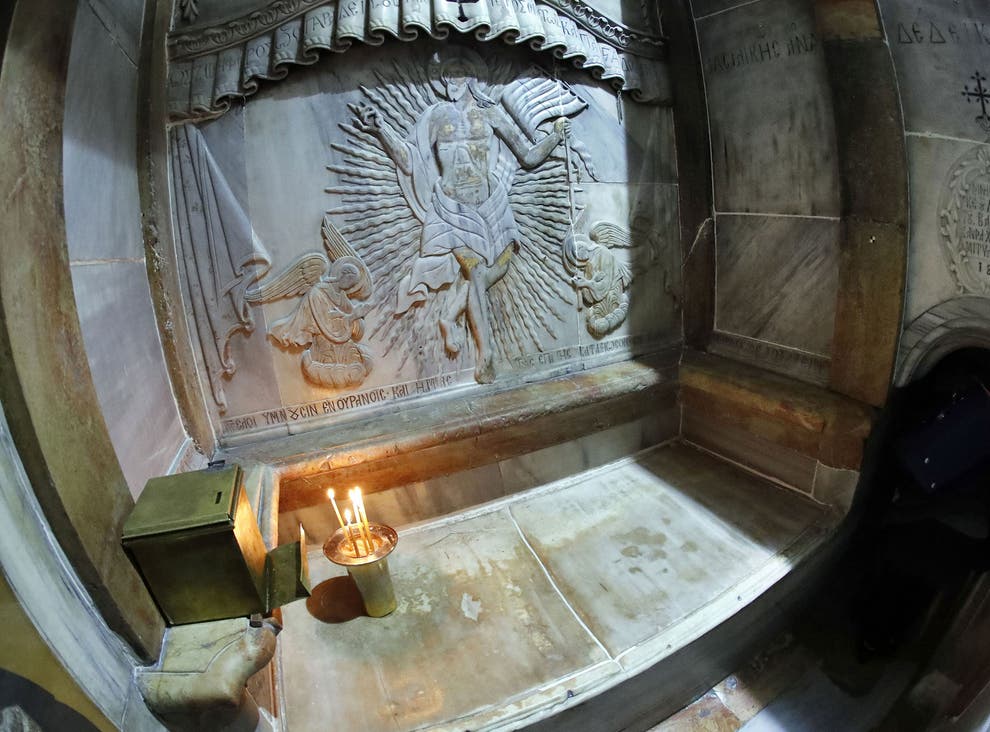
The tomb where Jesus's body is believed to have been laid, inside the Edicule in the Church of the Holy Sepulchre, Jerusalem


    "He is risen . . . he is not here. He is going before you to Galilee." (Mark 16:6-7)


    Christ is risen. Christ lives. Christ is the Lord of the living and the dead. He is the Lord of history.


    Christ is the Lord of a history that moves. He not only holds the beginning and the end in his hands, but he is in history with us, walking ahead of us to wherever we are going. He is not always in the same place.


    The cult of the Holy Sepulchre is Christian only insofar as it is the cult of the place where Jesus is no longer found. But such a cult can be valid only on one condition: that we are willing to move on, to follow him to where we are not yet, to seek him where he goes before us -- "to Galilee".

---


Read the rest at the link below ...


Short booklet, "He is Risen", written by Merton in 1967 is HERE


He is Risen


Sunday, April 10, 2022

conscious suffering

Christ’s Entry into Jerusalem, 1842-1848 - Jean-Hippolyte Flandrin

"There is a piece of suffering which is a river that flows through the human condition and is part and parcel of our arising itself. Eckhart Tolle talks about it as the 'collective pain body of humanity.' Conscious awakening does not put a final end to suffering, but rather, allows us to bear it in a way that is luminous, generous, and ultimately sacramental. Through our prayers and our presence, we take our part in bearing the cost of this precious divine finitude, in which and through which infinite love is revealed. 

"What we do know is that great injustice, cruelty, physical pain, or betrayal, when consciously accepted and generously borne, can give rise to a peculiarly luminous and healing quality of love, and that this love radiates out from the site of the pain as a source of healing and hope for the entire cosmos."

Palm Sunday, Cynthia Bourgeault from 'Conscious Suffering'

Tuesday, February 8, 2022

The Mark of the True Revolutionary - The Young Gandhi


One of my Facebook friends posted this photo and story about the young Gandhi. Look at the clarity of his eyes, and his keen insight into the nature of human delusion and roots of racism. He had already found the path and courage of Nonviolence.

When Mahatma Gandhi was studying law in London, a professor named Peters had a bad attitude … but student Gandhi never lowered his head and they met very often.

One day Peters was having lunch at the university canteen, Gandhi came with his tray and sat down next to him.

The very arrogant professor said to him, “Student Gandhi, you don’t understand!” “Pig” and “bird” don’t sit down to eat together. “

Gandhi replies, “Be calm, Professor, I will fly!”

And the situation has changed. Professor Peters, filled with rage, because he understood that the student had called him “Pig”, decided to take revenge on the next exam …

But the student answers all the questions brilliantly.

Then the teacher asks him the following question: “Gandhi, if you walk down the street and find two bags, one with wisdom and the other with money, which of the two will you take?”

Gandhi replied without hesitation, “Probably the money, Professor.” ‘’

The smiling teacher tells him, “I would grab wisdom in your place, don’t you think?”

Gandhi replies, “Everyone takes what they don’t have, Professor.”

The already hysterical professor writes “IDIOT” on the exam sheet and returns it to the young man. Gandhi takes the sheet and sits down … after a few minutes he turns to the teacher and says, “Professor Peters, you signed the sheet, but you didn’t write my grade …”

~ If you let something hurt you … It will hurt you. But if you do not allow it, the thing will return to where it came from. ~

___ 

The following is from an essay by Lawrence S. Cunningham, a professor of Theology at the University of Notre Dame and a frequent writer about Merton. The entire essay, "Alone Among Many", is HERE.

"Nearly a half century ago, Thomas Merton wrote "Notes on a Philosophy of Solitude," an extended essay in which he pointed out that a person who enjoys solitude, by which he meant the quiet possession of the self, is the one less likely to be beguiled by mass movements, collective passions, the false siren of advertising and the lust for the ephemerally fashionable. True solitude (as opposed to individualism or "going it alone") is the cultivation of the sense of the self that permits us to adjudicate the cry of the mob and resist the lure of the moment.


Such self-possession is both a gift and a risk. It is most often a risk when acting against the consensus; such acts can earn scorn or, at worst, actual physical harm. Decades ago Ignazio Silone, the Italian political novelist, said that the first lethal blow against fascism came when the first brave person in a village chalked a large NO on the wall of the town square. Interior solitude has always been the mark of the true revolutionary. It was the inner force of Gandhi's resistance; it was the inner strength of a Solzhenitsyn whose inner life could not be broken by the horrors of the Gulag.


At a deeper spiritual level the cultivation of solitude is a necessary matrix out of which comes authentic prayer. By that is not meant that one must seek a solitary place (even though that may be a good thing to do on occasion) or go to a monastery for a retreat (also a good thing) or give up one's ordinary pattern of living. What it does mean is that if we are to pray, as opposed to saying prayers, we need the capacity to slow down, get in focus and become re-collected, albeit for a short period of time. The Bible describes that capacity as watchfulness, the alertness that brings our interior attention toward a single One. God says, through the psalmist, that we are "to be still and know that I am God" (Psalms 46:11). That stillness is the defining element of solitude."

Saturday, January 22, 2022

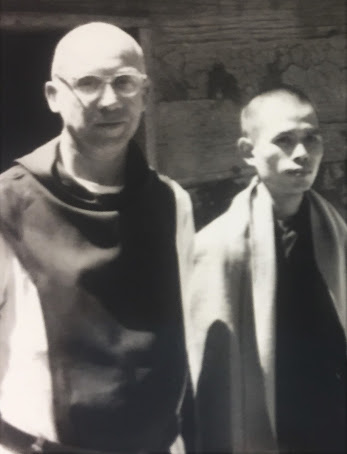
Two monks


Thich Nhat Hanh died yesterday. 

So many of my teachers connect to each other, going way back. It must be a wavelength that we find and recognize in each other, and then ride it together.

"... One of the persons Nhat Hanh had long hoped to meet while in the United States was Thomas Merton, the Trappist monk whose widely read books had done so much to revitalize contemplative spirituality. Merton was by then also known for his opposition to the war and also for his deep respect for Buddhism. In late May 1966, Merton welcomed Nhat Hanh, plus John Heidbrink of the Fellowship of Reconciliation staff, to the Abbey of Our Lady of Gethsemani in Kentucky for a two-day visit.

The two monks stayed up late into the night in Merton’s hermitage, sharing the chants of their respective traditions, discussing methods of prayer and meditation, comparing Christian and Buddhist aspects of monastic formation, and talking about the war.

Afterward, Merton said to his fellow Trappists, “Thich Nhat Hanh is a perfectly formed monk,” and that he regarded his guest’s arrival as an answer to a prayer. “In meeting Thich Nhat Hanh,” Merton said, “I felt I had met Vietnam.” Merton also wrote of their visit, calling Nhat Hanh his brother: “He is more my brother than many who are nearer to me in race and nationality, because he and I see things exactly the same way.”

- from "When America Met Thich Nhat Hanh", by  Jim Forest, Winter 2021 edition of Tricycle magazine.

Two monks. 

Thich Nhat Hanh references in louie are HERE

The Miracle of Walking on the Earth Is In The Here and In The Now ♡ Thich Nhat Hanh


From the NY Times:

“People talk about entering nirvana, but we are already there,” said the Buddhist monk, who died on Saturday. Here is a short selection of his remarks.

https://www.nytimes.com/2022/01/22/world/asia/thich-nhat-hanh-quotes.html  

This body is not me. I am not limited by this body.
I am life without boundaries.
I have never been born,
And I have never died.


Friday, February 19, 2021

An Ode to the Spirit


An Ode to the Spirit

In the peaceful places of my life, wherever I may find them, I will search for you. In the midst of the crowd, I will look for you. In the sound of laughter and weeping, I will listen for you. You are around me, within me, beside me, no matter where I am. You are everywhere at once and always. When I go up to the highest point of joy I know, you are waiting for me. When I fall to my lowest point, you catch me. When I am alone in the deep night, you hold me. You are forever, in all places, in every moment. You let me go at the right time. You release me to the open air. You trust me. And I, in all that I do, and say, and believe, trust you. I have since the beginning. I will until the end. You are my creator, my simple truth, what I believe and why I believe, the sum total of my life’s experience. I have made my choice and pledged my love. I am in this with you, in every way I can be, for as long as I can be, until your mystery surrounds me and the next dream begins.

~ Steven Charleston is a Native American elder, author, and retired Episcopal bishop of Alaska. Adjunct Professor of Native American Ministries, Saint Paul School of Theology at OCU, Citizen of Choctaw Nation.

Sunday, January 31, 2021

a light that is always ultimately personal


The following is from Jonathan Montaldo, promoter of the Merton legacy and teacher of the monastic contemplative tradition. See MONKSWORK.

Paul Evdokimov, the eastern orthodox theologian, has written that “A saint is striking because of a countenance unique in the world, because of a light that is always ultimately personal. He or She has never been seen before.” 1

Thomas Merton’s countenance, too, has never been seen before and the light from his spiritual legacy for us is ultimately personal. He will have no successors.

He wrote in his journal after a formal “Day of Recollection” on the Feast of the Guardian Angels, October 2, 1958:

“My vocation and task in this world is to keep alive all that is usefully individual and personal to me, to be a ‘contemplative’ in the full sense and to share it with others, to remain as a witness to the nobility of the private person and [the private person’s] primacy over the group.” 2

Thomas Merton’s literary vocation to love the world by speaking out to it courageously, his monastic vocation to listen intently as the world spoke back, and his whole life’s urgency to live in and for Truth, is his enduring legacy. Those who read his words with respect will honor him, now in their own time, by enacting their own vocations to “fearless speech” and by living out their own “courage for truth”. Continuing our own inner journeys toward spiritual liberty is more important than any bows we make to the dead spiritual master. 3

Honoring Thomas Merton’s compassionate transparency demands that we, who claim to hear his voice, should stand on our own feet, find the pitch of our true voices, open our lips, and sing. 4
[JM, England, 2012]]

1. Paul Evdokimov Woman and the Salvation of the World. Anthony P. Gytheiel, translator (Crestwood, NY: St. Vladimir’s Seminary Press, 1994: 47-48.
2. A Search for Solitude: 221.
3. Paraphrasing a remark of Robert Cole’s in reflecting on his mentor Eric Erickson.
4. "The sense of the sacred, of the 'numinous' without which there can hardly be any real or living religion, depends entirely on our ability to transcend our own human signs, to penetrate them and pass beyond their manifest intelligibility into the darkness of mystery, to grasp the reality they can suggest but never fully contain. The mere repetition of consecrated formulas is not, therefore, holiness itself. But words are the only normal keys by which we can unlock, for one another, the doors of the sanctuary and direct one another into the Holy of Holies where each of us must enter the sacred darkness in love and in fear, to find the Lord alone.” Thomas Merton The New Man: 88

Monday, November 30, 2020

with hearts attending to the skies we cannot understand


Path to Payne Hollow, watercolor by Harlan Hubbard
Night is our diocese and silence is our ministry
Poverty our charity and helplessness our tongue-tied
sermon.
Beyond the scope of sight or sound we dwell upon the air
Seeking the world's gain in an unthinkable experience.
We are exiles in the far end of solitude, living as listeners
With hearts attending to the skies we cannot understand:
Waiting upon the first far drums of Christ the Conqueror,
Planted like sentinels upon the world's frontier. 

from The Quickening of John the Baptist, On the Contemplative Vocation. Poem by Thomas Merton

Read the full poem HERE

Sunday, November 1, 2020

The Essence of all Spirituality is Presence


The essence of all spirituality is presence,
a state of consciousness that transcends thinking.
There is a space behind and in between your thoughts and emotions.
When you become aware of that space,
you are present,
and you realize that your personal history,
which consists of thought,
is not your true identity and is not the essence of who you are.
What is that space, that inner spaciousness?
It is pure consciousness,
the transcendent "I AM" that becomes aware of itself.
The Buddha calls it sunyata,
emptiness.
It is the "kingdom of heaven" that Jesus pointed to,
which is within you
here and now.

-- Eckhart Tolle

Thursday, October 29, 2020

Everything Matters

[I seldom (never?) quote Richard Rohr's daily posting in its entirety, but this one hit home for me. The reflection is from Cynthia Bourgeault. It belongs here.]

 Thursday,  October 29, 2020


Only the Divine matters,
And because the Divine matters,
Everything matters.

                                                             —Thomas Keating, “What Matters”

The simplicity of the final poem in The Secret Embrace speaks eloquently of what I (Richard) know more deeply to be true with every passing year. It’s the incarnational message at the heart of the Gospel: everything belongs! It is a Christ-soaked universe. As we near the end of this series, Cynthia Bourgeault shares her understanding of Thomas Keating’s final legacy to us. 

In October 2018, two weeks before he died, Thomas Keating emerged briefly from four days in what appeared to be a coma to deliver an extraordinary final message beamed straight to the heart of the world. [1] Acknowledging that “an extraordinary moment of civilization seems to be overtaking us,” he urged the human family to scrap old approaches based on religious or political dogma and “begin a new world with one that actually exists,” a world whose truth is guided by “silence and science” and whose heart is revealed in a universal resurgence of human compassion and creativity. “We need to find ways to make these really happen,” he said. “I leave this hope in your hands and hearts coming as a real inspiration from the heart of God.”

Two momentous years later, his words seem more prophetic than ever.

Of the many insights Thomas Keating has given us in these poems, two gifts stand out in particular. The first is that he has completely reframed the traditional Christian notion of God, offering us a powerful new roadmap with which to make spiritual sense of our contemporary world. In this short poem of eleven laser-like words, Thomas smashes through centuries of theological barricades separating God from the world and contemplation from action, offering instead a flowing vision of oneness within a profoundly interwoven and responsive relational field.

To have this universal wisdom affirmed so forcefully by one of Christianity’s most revered elders creates a powerful new incentive for a compassionate re-engagement with our times. Practically speaking, the map affirms that our actions, our choices, our connections bear more weight than we dare to believe. We are neither isolated nor helpless but immersed in a great web of belonging in which divine intelligence and compassion are always at our disposal if our courage does not fail us.

The second gift awaiting us in these poems is their powerful reaffirmation that the access route to all new beginning comes by leaning into the diminishment, stripping, and emptiness. Not by trying to distract ourselves, anesthetize ourselves, or use our spiritual tool kit to re-establish the status quo. New beginning is intrinsically disorienting and anguishing; it builds on the wreckage of what has been outgrown but not yet relinquished. As the veils are lifted and our familiar reference points dissolve, it is only on the timeless path of surrender (a.k.a. “letting go,” “consenting to the presence and action of God”) that we find our way through the darkness and into the new beginning. Godspeed and know that we travel the path together!

Wednesday, October 28, 2020

a monstrous irrationality

"We are victims of a monstrous irrationality

- which we call 'means of communication' -

but which in actual fact obstructs real communication.

A vast machine which processes 'events' and reduces them to gibberish

in which reality is a total loss."

- Thomas Merton

Monday, October 26, 2020

Wendall Berry Sabbath Poem

Tanya and Wendell Berry working in the field, Courtesy of Platform Media Group

Praise “family values,”

“a better future for our children,”

displacing meanwhile the familiar

membership to be a “labor force”

of homeless strangers. Praise

work and name it “jobs.”

With “labor-saving technology”

replace workers at their work

and hold them in contempt

because they have no “jobs.”

Praise “our country” and oppress

the land with poisons, gouges,

blastings, the violent labors and

pleasures of the unresting displaced,

skinning the earth alive.

This is the way, the truth, and the life.


Welcome the refugees set free

from the “nowhere” of rural America,

from the “drudgery” of the household

and the “mind-numbing work”

of shops and farms, into 

the anthills of “liberation”

the endless vistas of “growth,”

of “progress,” the “limitless adventure

of the human spirit” rising

through inward emptiness into

“outer space.” Welcome

the displaced naturally “upwardly

mobile” to their “better world”

as they gather bright-lighted

in “multicultural” masses

in the packed streets. Catch 

those who inevitably

fall from the light-swarm

in meshes of “safety nets,” “benefits,”

“job training,” the army,

the wars, mental hospitals,

jails, graves. Forget

vocation, memory, living

and dying at home. This

is the way, the truth, and the life.


Flourish your weapons of official

war where they are needed

for peace, bring death by chance

but needfully to small houses

where children play at war

or a wedding is taking place

so that the bride and the groom

will not be separately killed,

for you have an enemy

somewhere, who must be killed.

Therefor forgive the unofficial

entrepreneur who brings

your weapons to your 

school, your office, your

neighborhood theater, bringing

death randomly but needfully,

for his enemies are his

as yours are yours. This is

the way, the truth, and the life.


Wendell Berry

Sabbath Poem XIV, 2012

Pentecost

  Kelly Latimore Icon "You have made us together, you have made us one and many, you have placed me here in the midst as witness, as aw...