Thursday, November 14, 2013

"Political" poems

Lax at St. Bonaventure University, late 1940s
"Anyone can produce poems concerned with the world, and what to think about the world, and what can we do about the things in the world.  But to say that someone who writes about what can we do about things is talking in a "political" way is only a way of labeling.  I'm sure there are many entries in my journals in which I ask myself what can we do about the world. 
"Our idea with PAX was to take pieces and put them in order; a "harmony of order" as St. Thomas said.  Getting things in order is a good thing.  As far as art goes,  I think that beauty is the tranquility of order.  With PAX, what we thought that we should do is have artists working for peace, not by making peace posters, but by making the best art they could, and by letting us publish it, and by letting the world see what harmony and beauty there can be in the world when people are working on art instead of on war.  I think that was the essential idea about PAX.  And, in general, people did contribute, and they contributed with very good heart.  I think there were eighteen issues of it.   We planned it all in Paris.  But we weren't really able to publish it until JUBILEE began, and then Ed Rice let me do it.  Berhard Moosbrugger was in on the plan from the beginning, and he liked it too."

- Robert Lax from an interview with Sigrid Hauff on Patmos, September 1999

Friday, November 8, 2013

the river and the sea (Lax poem)

Photograph by Edith Feuerstein Schrot
does
eve
ry
riv
er
run
to
the
sea

&
is
the
sea
a
home
for
me
?

Robert Lax

Tuesday, November 5, 2013

Merton Icon by Fr. Bill

St. Andrei Rublev Icons represents the art and iconography of William Hart McNichols.

BY CHRISTOPHER PRAMUK

In an informal talk in Calcutta, just weeks before his death, Thomas Merton described the monk, and thus himself, as a “very strange kind of person,” a “marginal person, who withdraws deliberately to the margin of society with a view to deepening fundamental human experience.” The monk in the modern world, he continues, “is no longer an established person with an established place in society. 'The monk' is essentially outside of all establishments.”

Weeks later, in a conference just hours before his death, Merton recalls a Buddhist monk during the Chinese invasion of Tibet who spoke these words to another monk in great distress, “From now on, Brother, everybody stands on his own feet.” Merton repeats the line, describing it as “an extremely important monastic statement.” From now on, everybody stands on his own feet. Merton gestures further: “You cannot rely on structures. The time for relying on structures has disappeared.”

It seems to me that Fr. Bill’s icon beautifully reflects Merton’s witness as a marginal person, standing at the margins, standing on his own feet. Yet Merton’s gaze, perfectly at home outside his hermitage, is not that of a rugged loner, indifferent to his visitor. His gaze welcomes and invites me in.

It is She, Sophia, who welcomes and invites me in: Wisdom-child in flame dancing playfully over Merton’s head. She and Merton are one, and we are three, encircling in time and space like Rublev’s Trinity. I am at peace. We are friends. The time for relying on structures has disappeared.

The monk is a marginal person, and I confess, I want so much to follow. Cor ad cor loquitor; heart speaks to heart. From before all beginnings, Her heart speaks silently to my heart, calling me forth with gentleness into being, into a brand new day.

The monk is a liminal man, in wool cap and denim jacket, guarding the doorway between life and death. Why do you seek the living among the dead? There is music on both sides, but stay awake, and let Life be your song! It is life and love that makes you dance. How the valley awakes! The cool hand of the nurse, whispering “Mercy within mercy within mercy.” The bridegroom is coming.

The frost at Merton’s feet, spread thinly over Kentucky bluegrass, is familiar to me. I am a native of Kentucky, where gray-damp winters drove us children indoors by late afternoon, and necessitated conversation and family play after dinner, deep into the evening, around smoking wood fires that my father loved to build. A Child’s heart, sometimes frozen, still beats within me. I want the frost to melt away.

In Fr. Bill’s icon Merton comes to us as heir to Julian of Norwich, heralding the eschatological secret of Christian hope. Gazing on me, gazing on him, he reminds me, “Do not be afraid.” What was fragile has become powerful. I loved what was most frail. All things are pregnant with expectation.

“Wisdom,” cries the dawn deacon, and I am learning, even as I fall back into sleep, how to listen. A child again in Her mercy I am learning to stand on my own two feet.

Thank you, Fr. Bill, for showing us, so humbly and lovingly, how to listen, and for bringing into birth this remarkable icon of Thomas Merton.

***
Christopher Pramuk is the author of four books, including Hope Sings, So Beautiful: Graced Encounters Across the Color Line (Liturgical, 2013) and Sophia: The Hidden Christ of Thomas Merton (Liturgical, 2009), which was awarded the International Thomas Merton Society’s 2011 “Thomas Merton Award,” a.k.a. “The Louie,” its highest honor. A lifelong musician and student of African American history and spirituality, Pramuk’s present work focuses on racial justice and interracial solidarity in society and church.

Link to Fr. Bill's icon: Holy World Evangelist Thomas Merton

Friday, November 1, 2013


From the American poet, Robert Lax:


Unconditional love. That’s the bottom line. Everything is here because of love. That’s why we were created — to love. Love keeps things going, not just for now, but forever. Love gives life and makes sure what’s around today will be around tomorrow. It’s all about compassion. That’s what the cosmos best responds to. 
Every moment is a gift. Relax, get into the moment, and do all you can to listen to it. I mean, really, really listen. Be present to the moment with everything you are.
It takes practice. After you’ve listened for a while, you start responding. I think you start working your gifts in response to what you’ve heard. You become appreciative of the moment. You give back because you begin to see how everything is on loan, a gift from God. 
Learn how to look. Take time to look to see what’s right there in front of you, to let what you see sink in. When you look at a flower opening or a tree moving with the wind, you just relax and take it all in. Try and see everything like that, if you can. 
Looking and listening lead into everything….. You become more totally aware of reality. It’s so true — everything we need to live well is already within our possession. Wisdom is right before our very eyes. 
Be gentle and patient both with yourself and with others, no matter what comes along. In this way, waiting becomes a fulfilling, very meaningful experience. If you live gently, honorably, focusing on the cultivation of your heart, good things are sure to follow. 
Prayer is a way of doing instantaneous good for all things in all places. It’s a way of sending out love everywhere at one. It’s a power that everyone has access to, and it can transfigure the world. Prayer makes everything you do more real, lasting, meaningful and fruitful. Through prayer, everything just flowers and flows. 
Try to live as purely and as simply and as gently as you can. Relax. Be flexible. Be forgiving. Be creative. Be loving. You are a peacemaker. Those who cross your path may need you. 
Listen, be discerning, use all the radar you can generate in your waking moments. Try to keep the balance. The whole world’s watching, counting on you to do the right thing, the loving thing. So let in the light whenever, wherever you can.

From http://ncronline.org/blogs/road-peace/wisdom-robert-lax-cultivate-exercise-compassion and based on “The Way of the Dreamcatcher: Spirit Lessons with Robert Lax, Poet, Peacemaker and Sage” by Steve Georgiou.

Sunday, October 20, 2013

Christ in the Desert

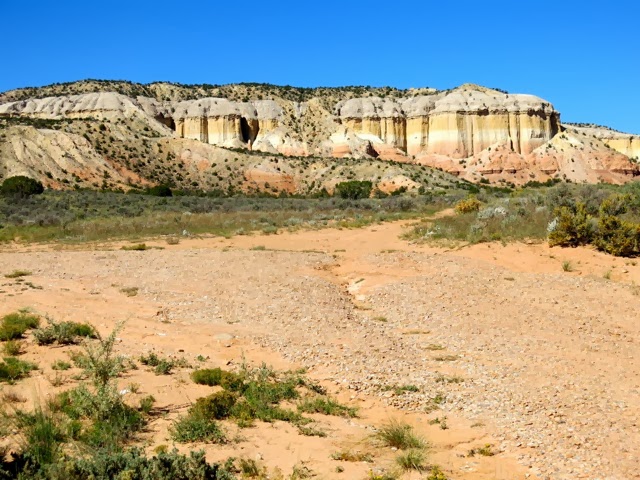
Earlier this month I visited this monastery in Abiquiu, New Mexico.

"The place was chosen with careful deliberation, and it is admirable. Thirteen miles by dirt road from the nearest highway, the monastery rises at the point where the canyon narrows and road vanishes into rock and brush. Still surrounded by visible traces of an ancient Pueblo culture, it is at the frontier on which the Pueblos had to protect their country against marauding Apaches. 
"The rocky land is even more lonely and desolate today than it was then (for the Indian villages have disappeared). The monastic Church, designed by the Japanese architect George Nakashima, fits perfectly into its setting. Stark, lonely, stately in its simplicity, it gazes out over the sparse irrigated fields into the widening valley. The tower is like a watchman looking for something or someone of whom it does not speak. This architectural masterpiece is a perfect expression, in adobe brick and plaster, of the monastic spirit. 
"Monastic hospitality does not conflict with the "desert spirit" -- on the contrary, it is an essential element in the desert tradition, for the first monks had to be concerned for the welfare of those who got lost in the desert, or came to them in spiritual crisis."

- Thomas Merton, who visited this monastery in 1968
Here are some more photos of the monastery:
 I had always assumed that this was a Trappist monastery, since Merton made special effort to visit here before his trip to Asia in 1968.  However after seeing how different these monks looked (and acted), dressed all in black rather than the black and white habit of the Trappist, I found out that they were a Benedictine order of monks.

I've come to the conclusion that Merton made the visit more from an artistic than religious interest (as if the two can be separated in him).  The monastery was built in 1964, the church designed by George Nakashima, a Japanese American woodworker and architect.


Merton also hoped to visit with Georgia O'Keeffe while he was in Abiquiu, but that didn't work out.

The monastery is 13 miles off the main road, deep in the quiet wildness of the northern New Mexico desert.  Not an easy place to get to.


Thursday, August 29, 2013

connecting the dots


On this day that we honor, celebrate, and vow to continue to struggle the 50th anniversary of the March for Jobs and Freedom on Washington led by Dr. Martin Luther King, we must remember something that was not heard in the official commemorations in Washington today: the way in which the struggle here at home in terms of poverty is related to the struggle abroad in terms of America’s militarism. 
We have to connect the dots between what Martin called the triple giant of evil: racism, materialism, and militarism.
Martin was pressured not to make this link, and in fact it took him from 1963 till the famed 1967 Riverside church speech to speak “against the apathy of my own soul” and break his own silence against the war in Vietnam. 
The result was powerful, controversial, and as of today, still a task for all the real followers of Martin to heed. 
- See more at: http://omidsafi.religionnews.com/2013/08/28/connectingdots/#comment-36876

See: The Martin Luther King connection 

Wonder

Among the many things that religious tradition holds in store for us is a legacy of wonder.  The surest way to suppress our ability to understand the meaning of God and the importance of worship is to take things for granted.  Indifference to the sublime wonder of living is the root of sin. 
Awareness of the divine begins with wonder.  It is the result of what man does with his higher incomprehension.  The greatest hindrance to such awareness is our adjustment to conventional notions, to mental cliches.  Wonder or radical amazement, the state of maladjustment to words and notions, is therefore a prerequisite for an authentic awareness of that which is. 
Abraham Joshua Heschel

Pentecost

  Kelly Latimore Icon "You have made us together, you have made us one and many, you have placed me here in the midst as witness, as aw...