Showing posts sorted by relevance for query jim forest. Sort by date Show all posts

Friday, January 14, 2022

Jim Forest

Jim Forest

Jim Forest died yesterday. 

It seems like I've known about Jim as long as I've known about Merton. He was always part of the story(s) that interested me. Saying no to war, resisting. Being Catholic. Prayer. 

It's no accident that Thomas Merton, Dorothy Day, Daniel Berrigan and Thich Nhat Hanh all trusted Jim Forest to tell their stories. Jim saw through to the truth of the situations, and the truth of the person. His writing was simple. He said what was obvious. 

Much of this blog revolves around Jim's contributions. 

http://fatherlouie.blogspot.com/search/label/Jim%20Forest

https://fatherlouie.blogspot.com/search?q=jim+forest

I met Jim once when he was giving a retreat on Dorothy Day in North Pittsburgh. Jim's deep emotional vulnerability is what surprised me about him. He wore no mask. He openly cried before the audience. When he greeted me he hugged me and hugged me for a very long time. I will never forget that.

I will never forget Jim. 

Jim wrote about famous people. His own life was more humble and unknown. A beautiful man. 

Rest in Peace, dear friend.

Friday, January 31, 2014

Prades France - Birthplace of Thomas Merton

A view of the house where Thomas Merton was born on January 31, 1915.  Prades France. Photo by Jim Forest.
Several years ago this sign was placed on the house where Merton was born.  Photo by Jim Forest
Sign on the street where the house is located.  Photo by Jim Forest
Another view of the house where Merton was born in Prades France.  Photo by Jim Forest.

I think of the young American woman, an artist herself, married to an artist from New Zealand and living in this house in southern France giving birth to her first child, a son.  This was 1915 - before cars, before airplanes, before radios etc.  How that young woman would never know what would become of this first-born son, yet all the love and expectation and wonder must have been there.

How quiet this place looks.  

HT: Jim Forest

Friday, January 21, 2022

Only the rice loves you

Plum Village Tribute to Jim Forest

Remembering Jim Forest - By Sister Chan Khong

Jim Forest was a true man of peace, of reconciliation, and of love. Jim gave me—and continued to give me—a lot of inspiration since we first met him at the office of the Buddhist Peace Delegation at Maison Alfort near Paris, while we were working to call for peace in Vietnam. Thanks to his deep background as a real man of Peace, Jim understood and absorbed everything our teacher Thich Nhat Hanh (“Thay”) shared with him, and he wrote many wonderful articles on Thay’s message and teachings, in particular in the Fellowship Of Reconciliation magazine. Jim always had a deeply attentive look and seemed to “drink in” everything we shared; we never felt disappointed when we read his summaries and reports for readers. With his talent in writing Jim reported so many of Thay’s teachings during that challenging time, and he shared and commented on them in a profound and sometimes very humorous way for the reader, as in the wonderful article “Only the rice loves you.” 

Jim also helped publish the English translation of Thay’s theater script, “The Path of Return Continues the Journey.” Many of Jim’s earlier peace writings were printed in the Fellowship of Reconciliation magazine, and he shared with the wider American audience many deep exchanges about Sister Nhat Chi Mai (one of the first and profound students of Thay, who immolated herself for peace) as well as the story of the four social workers of the School of Youth for Social Service who were assassinated on the bank of the Saigon River. He also introduced to the community of the Fellowship Of Reconciliation Thay’s pioneering and accessible book on mindfulness practice: The Miracle of Mindfulness. In Jim’s memoirs, Eyes of Compassion: Learning from Thich Nhat Hanh, published last year by Orbis, Jim shared his profound and insightful experience of our teacher. Jim captured with clarity, compassion, and a historian’s eye for detail, many pivotal moments in Thay’s peace work during the 1960s and 70s. Jim’s love, integrity, friendship and open-hearted learning shine through in his writing and light up the way for others to follow.   

Only the rice loves you.   


Wednesday, March 18, 2009

Jim Forest British Columbia talks

From Jim Forest, always a great source for Merton commentary and lore:

Here are links to the texts of several talks given during my two-week stay in British Columbia. All but the last -- on Erasmus -- have a Merton connection. (My host was the Thomas Merton Society of Canada.) There was one other talk given at Holy Nativity Orthodox Church, but it was given without a written text.

Thomas Merton: Peacemaker in a Time of War
http://incommunion.org/forest-flier/jimsessays/thomas-merton-peacemaker-in-a-time-of-war/

An Army that Sheds No Blood: Thomas Merton’s Response to War
http://incommunion.org/forest-flier/jimsessays/sheds-no-blood/

(The first of the two Merton peace-related essays, with its Indiana Jones beginning, was intended for an audience that would include many people not all that familiar with Merton.)

Thomas Merton: Peacemaker in a Divided Christendom:
http://incommunion.org/forest-flier/jimsessays/undivided-church-3/

We Will All Be Changed: Reflections on the Transfiguration
http://incommunion.org/forest-flier/jimsessays/transfiguration/

Give Peace a Chance: Peacemaking as common ground:
http://incommunion.org/forest-flier/jimsessays/give-peace-a-chance/

Does Erasmus have anything to teach us in the 21st century?
http://incommunion.org/forest-flier/jimsessays/erasmus/

A photo journal kept while I was in Canada:
http://www.flickr.com/photos/jimforest/sets/72157614656929699/

Thanks, Jim!

Monday, October 17, 2011

Dorothy Day, Thomas Merton, and Jim Forest

Jim Forest speaking at the Nazareth Retreat Center in Pittsburgh, October 15, 2011. (The guy next to me had a "Smartpen" - see LiveScribe.com!  I had never seen one in action before.)
Over the weekend I went to a "day retreat" on Dorothy Day, led by Jim Forest, in North Pittsburgh.  I have corresponded for awhile with Jim about Thomas Merton, and was honored to be able to meet him in person.

His person carries a profound presence and sincerity that I could only glimpse from his internet persona.  I was quite blown away.  I can see why both Merton and Dorothy Day were drawn to him as a young man, and trusted and believed in him.  He is, as far as I can tell, one of the most reliable writers alive to carry on their legacies.  Jim speaks simply and in that simplicity is much truth and power.

I met several people at the event that know people that I know from my Florida peace and justice connections.  It was held at a Nazareth Retreat Center that felt very familiar to my own Kentucky roots.

Here is a link to a US Catholic interview with Jim about the friendship between Dorothy Day and Thomas Merton. (Thanks, Bryan!)

This is the Nazareth Center, which looks very much like the Nazareth in KY.
Dorothy Day attended silent retreats here which were led by a Pittsburgh priest, Fr. John Hugo. Fr. Hugo was a spiritual guide to Dorothy.  

This is the chapel where Dorothy prayed.

Friday, June 6, 2008

Rome Pilgrimage


Santa Maria in Trestevere


The ceiling of the St Zeno Chapel of Santa Praxedes
Photographs by Jim Forest
(are these photos not absolutely gorgeous?!)
Jim Forest has been in Rome with the Canadian Thomas Merton Society, and keeping a photo journal (on Flickr) that includes the catacombs, monasteries, and the Christian iconography that survives in some of Rome’s most ancient Churches.

As Jim notes in his introduction to the photo journal, Merton traveled to Rome in 1933 when he was 18 years old and was especially drawn to the ancient churches and the art from Christianity’s first millennium.

“I was fascinated by these Byzantine mosaics. I began to haunt the churches where they were to be found, and ... all the other churches [among them Saints Cosmas and Damian, Santa Maria Maggiore, Santa Sabina, the Lateran, and Santa Costanza] that were more or less of the same period.... Without knowing anything about it, I became a pilgrim.” (Seven Story Mountain)

Jim’s own pilgrimage through these same churches is extraordinary, with references to the particular Churches and icons that Merton mentioned in his autobiography. The Flickr photo journal is here.

Jim Forest is the author of a number of books about Merton, and the recent, “Praying with Icons”. Thanks, Jim, for sharing your photographs, they are wonderful!

Saturday, May 26, 2007

thomas merton's advice to peacemakers


Click here to read: “Thomas Merton’s Advice to Peacemakers”

In 1959 Jim Forest was 18 years old and working for the U.S. Navy. At the bus station in New York City he picked up Merton’s autobiography, “Seven Story Mountain”. He was hooked.

A year later, while visiting the Peter Maurin Farm on Staten Island, Jim heard Dorothy Day reading one of Merton’s letters. He was amazed. He had been under the impression that the monk of Seven Story Mountain was cloistered behind walls and had closed the door to the world forever yet here he was corresponding with one of the America’s more controversial figures.

In 1961, upon his discharge from the Navy, Jim joined the Catholic Worker Community in New York thinking that it would be his own stepping stone to the monastery. Knowing of his interest in Merton and attraction to the monastic life, Dorothy began sharing her Merton correspondence with Jim. By this time Jim had read more of Merton’s books. Merton and Jim began their own correspondence.

In late 1961 Merton invited Jim to Gethsemani. Their friendship and correspondence continued until Merton’s death in 1968. (probably longer :-)) Jim went on in life to be a predominant presence in the formation of the Catholic Peace Fellowship and the Orthodox Peace Fellowship. His correspondence with Merton is extensive, as is his writing about Merton. His book, “Living with Wisdom”, is one of my favorite biographies of Merton. Jim and his wife, Nancy, now live in Amsterdam.

On June 8, 2007, Jim will give this lecture, “Thomas Merton’s Advice to Peacemakers” at the Thomas Merton Society’s 10th General Meeting in Memphis Tennessee.

Reference: Essays by Jim Forest

Wednesday, November 2, 2011

Seven Story Mountain Book Covers UPDATE

UPDATE: Brian sent a photo of his 50th anniversary (1998) issue of Seven Story Mountain (see below).  Too bad it doesn't have the price on the cover to compare to the 75 cents and 50 cents copies!  I still have the First Edition hardcover that belonged to my parents, but alas, the jacket is long gone.

I am fascinated with the stuff that Jim Forest saw on his recent visit to St. Bonaventure University.  Jim is an excellent photographer and I would like to add some of his photos to the eclectic collection of the louie blog.  (All of Jim's photos from this trip are on his Flickr site HERE.)
 Photo by Jim Forest
Photo by Jim Forest
Photo by Brian Murphy(1998 50th Anniversary edition)

Monday, May 5, 2008

remembering merton (part 3) - fearlessness

One of the lines from the round table discussion that jumped out at me was Jim Forest’s remark about Merton’s fearlessness:

"This was another quality. I would call it the quality of fearlessness. That I think is one of the most important attributes of Merton: that he communicated to so many people what it is like to live a fearless life." - Jim Forest
I have been musing over this quality of fearlessness the past few days – what it is to live without fear or anxiety, with each day truly a gift and adventure. I believe that both Merton and Dorothy Day tapped into a wellspring of Life, living water that allowed them to live without fear. They both found within the context of Catholicism an incredible freedom and a way that opened out toward previously unimaginable possibility.

I wonder if, like Jim suggests, one can "catch" this freedom by being around a person who has discovered it? Can one point the way for another? Is it even possible for you to discover your own fearlessness by yourself? Or is it pure gift? Is it gift that is always given, but we discover how to accept?

Jim Forest goes on to add …


"If you read, as I am at the moment, the first of these volumes of his journals that are being published, you might keep it in the back of your mind while you are reading it, how open he is, how unprotective he is about himself, his future, and so on. There is some place where he just says that you have to abandon yourself completely, to love God and love your neighbour. This sense of abandonment. Not to be worried about the future and what will happen. Will you have the house? Will you have this and will you have that? Will people care about you? Will you be important etc. etc.? Although he didn't speak about it very often and perhaps never spoke about it so transparently as in these early journals, this theme that we see picked up very early in the journals is of simply abandoning yourself so that you can live very freely in the Resurrection because there is nothing actually to worry about. There's nothing we can do to prevent our death. There's absolutely nothing we can do to prevent a good deal of suffering in our own lives. It's all going to happen. And so you just say well that's going to happen. The form it will take remains to be seen. The only thing that actually matters is just simply living in obedience, living in attentiveness to this wonderful creation that's been given to us and which will carry us along in whatever way is necessary. This sense of the providence of God. Whenever you meet somebody like that, it's a life-changing experience. As much as people talk about it, when you encounter the reality of somebody who lives with that kind of absolute confidence in the providence of God, you are never the same again. It's very freeing."

Friday, May 2, 2008

remembering merton (part 1) - finding unity deeper than our differences

I happened upon a transcript of a round table discussion of some of Merton’s friends: Tommie O’Callaghan, Donald Allchin, Jim Forest, and John Wu, Jr., which was held in the late 1990's (1996?). These memories of Merton are especially personal, and make Merton feel much more real to me, so I will be excepting some from that transcript.

Isn't that interesting the way Jim Forest refers to Merton as "one of the great conservatives of the twentieth century"? I'd concur, and I agree with what Jim says about Merton being rooted in traditional and liturgical Catholicism, but I tend to think that Merton was radical - not conservative or liberal. He went deeper, to the root.

"... the sense that Merton had of the unity of the church. Now we can all see how deeply divided the church is, how mercilessly divided it has been by events in history. It's quite amazing when you encounter somebody who was so deeply nurtured by what is at the root of Christianity, the traditions of spiritual life of which the icon is one example. It's a very important one for him. That love of the stories of the early church, the spiritual practices of the early church, his readiness to receive from any part of the church, from Orthodox, from Baptist, from Episcopalians, Anglicans and so forth and so forth, and then we go outside Christianity to all the different traditions of spiritual life that he found so amazing, so interesting, so helpful, so important, this deep underlying sense of the connectedness, the oneness that stands beneath divisions. And it was never a denial of division but that the way to deal with this division was to go more deeply. That some events of a healing nature occur because we go more deeply. And it's not to heal the divisions that we go there but simply because we are in a process of coming closer to God.

I'm trying to think of moments with Merton where one could see something of this. It may not seem immediately relevant but I recall sitting on the porch of his hermitage with a Polish visitor to the monastery who had come with me from the Catholic Worker – he had arrived a few days later – an artist who had had some difficulty in his relationship with the Catholic church and was asking Merton to explain the Mass. And I have never heard anybody explain the Mass the way Merton did that day. He explained it as a dance, which I would only understand much later in my life really. It would just continue to sit in the back of my mind some place. Because I frankly didn't see the dance element very often in the Masses that I was attending, and less and less, one might say, as the years passed. But none the less gradually it became clear to me that it should be and sometimes is a dance. And how remarkable it was that he could see that and that it would occur to him at that moment to explain worship in terms of that graceful movement, the ancient ritual motions that we engage in if we are lucky. It's a very original way, it may seem, of explaining liturgical life but actually it's simply a return. Merton who was seen by so many as a radical turns out to be one of the great conservatives of the twentieth century, bringing back to us so many forgotten bits and pieces of the church that we simply forgot were there, just crumpled up in some sack in the attic somewhere, thrown into a sea-chest, that he would lovingly recover and present to us as news, which it was. "

~Jim Forest

Saturday, June 28, 2008

Retracing Merton’s steps: The Piazza Barbarina (more Roma Photos from Jim Forest)

Photos by Jim Forest - Piazza Barbarina and Bernini's Tritone Fountain, Roma
When 18-year-old Merton was in Rome in 1933 he stayed at a pensione at the intersection of Via Sistina and Via Tritone – the Piazza Barbarina. Jim guesses that the pensione that Merton stayed is the ochre one to the left in the photo above. It overlooks the Bernini “Tritone Fountain” that Merton mentioned in Seven Story Mountain.

In an unpublished early novel "Labyrinth," Merton writes:
“I found a place to live, a pension for Italians, people who worked in offices, not tourists. It took up a floor of a building on the corner of the Via Sistina and the Via Tritone. It was cheap and its windows caught all the sun. From my room I could look out on the Piazza Barberini where Triton blew his wreathed horn sending a thin stream of water high up into the warm air. On the other side of the Piazza, over some low buildings, cedars and cypresses lifted their head in the gardens of the Barberini palace. Outside the street door, on Via Sistina, both directions led uphill on one side to the obelisk in front of Santa Trinita dei Monti, on the other where the street came to the top of the Quirinal at Piazza Quattro Fontane. If I walked up there, I would look down another hill, and up another rise over toward the two towers of Santa Maria Maggiore.”

You can see more of Jim’s photos of the Piazza Barbarina here. To go to the next photo, just click on the right-hand-most thumbnail at the side. In the Piazza Barberini series, there are 11 or 12 images in all.

The main focus of Jim’s Pilgrimage to Rome is on the ancient churches of Rome, the ones Merton searched for so avidly during his stay in 1933, when he notes he first crossed the border from tourist to pilgrim. The complete set of photos is here.
Thank you again, Jim and Nancy, for so generously sharing your journey and your photos! They add a wonderful dimension to louie, louie especially for those who use the site to research Merton.

Thursday, January 20, 2022

Peacemaker - Love is the state of being Radically Awake

Photos by Robert Ellsburg

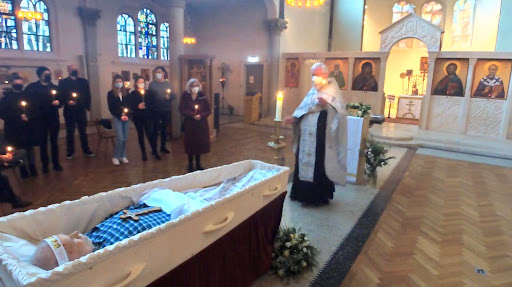
Jim Forest's funeral today in the Russian Orthodox Church of Saint Nicholas in Amsterdam.
At the very first conference of the Thomas Merton Society Great Britian and Ireland held in Southampton in May 1996 ‘Your Heart Is My Hermitage’, Jim Forest took part in the round table discussion between Merton’s friends and he also gave the Sunday homily. http://www.thomasmertonsociety.org/Heart/index.htm

Jim described love as a state of being radically awake:

'We can imagine that what will be strangest about heaven is how it is at once so familiar and yet so different. It will seem to us that in the first part of our lives, we were more asleep in the day than in the night. Our eyes were open but we saw so little. We heard so little. We understood so little. We loved so little. Not only our eyes but our souls were bricked over most of the time. Opposing love is fear. Recall Merton's insight: “The root of war is fear.” Still more important, recall the many times in the Gospel we hear the words, “Be not afraid.” We are not speaking here about fear of God; this is in fact that fear which should cure us of all our petty fears. But how often do we allow fear to prevent us from reaching out to others, to divide us from others, to make us into enemies of others, even to decide what we will do with our lives and with whom we will spend our lives? But in moments of love, we see more clearly and are able to live without fear in the freedom of the Resurrection. What freedom that is! As we sing throughout the Easter season in the Orthodox Church, the words falling on us like heavy rain on dry fields: “'Christ is risen from the dead, trampling down death by death, and upon those in the tomb bestowing life.”'

Deep wisdom, being radically awake. Fear of reaching out to the other which is hedged with all sorts of ego concerns. Sometimes silence is a way to get through. Simply being with the other. Allowing space for all of us to be in our broken state.

Jim's funeral, below, live-streamed today from the Russian Orthodox Church of St. Nicholas of Myra in Amsterdam. A day of great sadness and joy.


Sunday, August 12, 2018

Dan owned nothing


At Play in the Lions’ Den: A Biography and Memoir of Daniel Berrigan 
by Jim Forest
Orbis Books, Maryknoll, New York 2017

Reviewed by Sabina Clarke

In his compelling portrait of Daniel Berrigan, Jim Forest has given us a wonderful gift. He captures the amazing grace of Berrigan’s remarkable life as priest, poet, humanitarian, educator, anti-war activist and modern-day prophet. I could not put this book down.

Forest spent time with Berrigan as a young man and kept in touch with him over the years after he moved to the Netherlands where Dan visited him and his family. Theirs was a close bond. Consequently, his knowledge is firsthand. He succeeds in capturing the essence of Berrigan—his intellect, his humor, his compassion, his love for his community of Jesuits and his profound sense of humanity.

Unknown to most is that Berrigan was also the silent doer of daily works of mercy such as caring for the homeless, the dying and those suffering from AIDS when the epidemic first surfaced in 1984 — and when AIDS victims were shunned by society and blamed for their illness. Berrigan embraced them all and did not talk about it.

We find that Berrigan did not progress easily from acts of civil disobedience to acts of violence against military or government property. He was torn between his brother Philip who argued that petitionary nonviolence and civil acts of disobedience in protesting the Vietnam War were not working and that militant nonviolence was necessary and his close friend the Trappist monk Thomas Merton who argued against it. Gradually, he came to agree with Philip and together they began burning draft files and pouring their own blood on the files and drawing sometimes lengthy prison sentences.

Dorothy Day was also a strong influence and mentor. In the March 1965 issue of The Catholic Worker, she published Dan Berrigan’s first anti-war speech on the front page. Berrigan paid a high price for his militant acts of civil disobedience. He was often scorned and ostracized by his own community and on one occasion locked out of his residence, his belongings tossed outside on the steps. After giving a talk in support of Roger LaPorte, a former seminarian who immolated himself in front of the United Nations building protesting the Vietnam War, Berrigan was exiled by the Jesuits to South America — and returned only because of the huge public outcry and only on his stipulation that he be allowed to continue his peace work.

In all his university teaching positions he encouraged student activism and posed provocative questions to the University such as, “How did Cornell treat the migrant workers the University employed in its orchards?” and “What about its investment portfolios — segments of which connected Cornell to the military-industrial complex and the war in Vietnam.”

With a hundred of his Cornell University students he was arrested for the first time in 1967 at midnight on the steps of the Pentagon for protesting the Vietnam War. Reflecting on this he said, “For the first time, I put on the prison blue jeans and denim shirt, clerical attire I highly recommend for the new church.”

In 1975 he led a retreat on peace and reconciliation in Ireland and met with some members of the Irish Republican Army and was later criticized for being sympathetic to them. Even though he did not believe in taking even one life, he developed a rapport with their leader. When Hunger Striker Bobby Sands was on his deathbed, he was asked if he had one last wish before dying. He answered, “I would like to meet Father Berrigan.” With former US Attorney General Ramsey Clark, Berrigan flew to Belfast only to learn that Prime Minister Margaret Thatcher ruled that neither Dan nor Ramsey were allowed entrance. They stood vigil outside the prison as Bobby Sands slowly died.

Arrested more than 250 times,  he was noce on the FBI’s Most Wanted List. For four months led the FBI on a wild goose chase evading them until he was captured at a friend’s house on Block Island. In a particular daring escape after giving a talk at Cornell University and with agents from the FBI in attendance—after the lights dimmed he slipped into a costume of burlap sacking with a papier-maché head and aided by the Bread and Puppet Theater was whisked out into a waiting van and sped away. In an Oval Office conversation former President Nixon’s Chief of Staff Bob Haldeman wonders out loud where the Berrigans get their money for legal defense, Nixon responds, “They’ve got millions.”

Dan Berrigan died on April 30, 2016 — nine days before his 95th birthday. At his concelebrated Mass of the Resurrection, more than one thousand people attended. The homily was given by his friend and fellow Jesuit Stephen Kelly who opened with a greeting to the FBI, “We may let members of the FBI assigned here today know that it is Daniel Berrigan’s Funeral Mass of the Resurrection, so they can complete and perhaps close their files.”

In an interview with this writer in his apartment in New York in 2008, Daniel Berrigan said he entered the Jesuits at the age of eighteen because of its Spartan no-frills appeal when other orders were sending him literature featuring tennis courts and swimming pools and a more luxurious life. He stayed this way all his life. He gave away all his earnings from books and speaking engagements to the poor and others in need.

As his niece Frida Berrigan told a New York Times reporter on his death, “Dan owned nothing. He carried nothing. Whenever I traveled with him, he’d bring the little backpack of nothing. I’d pick him up and ask, ‘Is that all you have?’ He’d say, ‘Yes, that’s it. Let’s go.’” The final incantation of Father Kelly’s homily on Daniel Berrigan concluded with this…. that in his opinion… “Dan belonged among the Doctors of the Church.”

* * *
Wednesday, July 9, 2014

Benevolent Glancing

More on Sr. Mary Evelyn Jeger SND, who died this week. This is from an interview that Jim Forest did with her sometime in the mid 1980s:

"As I do not drive, I spend much of my life in buses. What better place, I thought, to experiment with benevolent glancing? At first I felt a bit awkward. I did not try to engage anyone’s eyes, so benevolent glancing was strictly a unilateral initiative. 
"A strange thing happened. I found I was praying. I don’t mean saying prayers. I was being attentive, alert and aware in a way impossible to describe. I was very much “with” a mysterious depth of reality. I was looking at others not merely with curiosity but with love. After all, love is what benevolence is all about: the word means “to wish another well.” 
"After a year of practice, I happened to meet a Buddhist priest. In his family he was of the fortieth consecutive generation of Buddhist priests. He said that the Buddhist way of seeing is different than the western approach. Westerners want to extract data, to “take” what they can from what they see, while a Buddhist tries simply to be present, to allow reality to present itself, to wait for it to come forward to meet the eye.
"What has this got to do with peace? Very much. Benevolent glancing is an art of attentiveness. Paying attention to what is before us is a way of prayer, even a definition of prayer. We know by faith that God is everywhere. Benevolent glancing is relishing God by being attentive to what is before us."  - Sr. Mary Evelyn Jeger SND

Read the full interview on Jim's website HERE.

An obituary for Sr. Mary Evelyn is HERE.

Sister Mary Evelyn Jeger SND b. February 15, 1928, d. July 4, 2014

HT: Jim Forest

Tuesday, June 17, 2008

San Lorenzo


Photographs of San Lorenzo Fuoiri le Mura, by Jim Forest

There is now a short essay about Jim and Nancy Forest's last day of pilgrimage in Rome when they went to the Basilica of San Lorenzo Fuoiri le Mura (St Laurence Outside the Walls). This turned out to be among the best preserved and most beautiful ancient churches in Rome. Probably it was one of the churches Merton found in his search for early Christian iconography.

Jim wrote an essay to accompany the day at San Lorenzo here. Without having to search through guidebooks and history books, you will be able to see the photographs with much knowledge and understanding. The photographs from this day are in a folder on Flickr here.

Thank you again, Jim and Nancy, for sharing your pilgrimage. The photos are so stunning, I keep looking at them again and again. Like ikons, they convey silence and so much mystery.

Thursday, November 3, 2011

nothing is on my mind (contemplative art)

Photo by Jim Forest
Not that I could ever afford it, but being captivated by all things Lax, I find this book fascinating.  It seems more like a work of art than a book.   The title intrigues me.  I practice Centering Prayer and one of the things that happens in this prayer is a movement away from "thinking".  Having nothing on your mind.  When thinking happens, you "ever so gently" (as Fr. Thomas Keating says) let go of it.

The book contains extracts from the Lax journals A, B and D.  Only 25 books were made by the German press, Edition Schwarse Seite.  63 hand bound pages on hand made paper.  $1500 each.  If I had money, I might buy one.  The one photographed here is at St. Bonaventure University in Olean NY, home of the Lax Archives.
Photo by Jim Forest
I've always suspected that Lax was a natural contemplative, and his writing, like the artworks of Ad Reinhardt leads one toward this contemplative kind of non-thinking awareness. Lax blurs the line between visual and literary art (and a lot of other things), but ends up with utterly simple utterings.

Prospectus: "Infinity's a pretzel curve. Notes from journals, one of a complete day, wandering, moving in circles, like talking on different levels. Selected parts from notes on other days are concentrated, calm and meditative, with delicate humor. Lax's kind of writing demands a slow reading, the reader has to put syllables together to words. Graphics and texts try the impossibility of capturing in paint or words in song or by any other art or in any other medium the actuality of the object."
Interestingly, during his last year Steve Jobs was interested the art of Mark Rothko.  Rothko's work is considered "spiritual".   He created Rothko Chapel in Houston, a place for non-denominational contemplation.  Jobs was looking for art that could inspire people working at Apple.

Wednesday, August 26, 2020

Contemplation & Resistance (3) - Accepting things

NHAT HANH: ... If you cut yourself off from something -- a tradition, a community -- the hope of things will be lost. Right at that moment. So it is not a problem of a word or a term -- it is the problem of life. And that problem of being simultaneously inside and outside yourself is a very wonderful idea. Not an idea but a way of life, a way that retain one's self and the link between one's self and the other part of one's self.

DAN: This was very much a part of the style of Merton -- the inside/outside. And it had very rich consequences, I think. For him and for others. He used to say that he would never become a monk again, but now that he was a monk, he would be a monk. Absolutely. Yes.

JIM FOREST:  A man playing hide and seek with tradition.

NHAT HANH: Anyway, being a monk or not being a monk, that is not the problem. The problem is the way you are a monk or the way you are a non-monk. I think if we greet events in that way, we can master the situation.

In China, they tell the story of a man who lost his horse. He was sad and he wept about it. But a few days later the horse returned with another horse. So the man was now very happy. His loss turns out to be lucky. But the next day his son tried the new horse and fell and broke one leg. So now it is not good luck any more, but bad luck. So he deserts the other horse and takes his son to the hospital and is content with what he has. So they say, if you greet these event with a calm mind, then you can make the most of these events for the sake of your happiness. That's not me, but the Chinese! (Laughter.)

-from a slightly edited transcript of a conversation recorded in Paris in 1973 by Jim Forest between Thich Nhat Hanh and Daniel Berrigan. 

Tuesday, March 3, 2020

Dan Berrigan's letter to Ernesto Cardenal

Credit...Mario Tapia/Barricada, via Associated Press

Jim Forest really does connect all the dots. Cardenal, an admired Latin American poet and priest, served in the Sandinista government of Nicaragua. He actively supported revolution (and violence). During the 1980s, the Vatican publicly demanded that he resign from his government position.

The following is from Jim Forest's biography of Dan Berrigan, "At Play in the Lion's Den". I quote it in its entirety because it is all so important:
 In 1966, after returning from his first trip to Latin America, Dan had briefly questioned whether nonviolent approaches could provide an effective means of overcoming the military dictatorships that ruled so many countries in that continent. In the years that followed Dan became increasingly convinced that there was no alternative to nonviolent methods and attitudes for those who sought to model their actions on the example and teaching of Jesus. On this issue he entered into a public debate with his friend and fellow poet and priest, Ernesto Cardenal, who took part in Nicaragua’s Sandanista revolution and, after its victory, became Minister of Culture. 
In November 1977, in an interview published in the Costa Rican journal Tiempo, Cardenal recalled how he had initially favored nonviolent methods of struggle. However, after the destruction of his community, Solentiname, by troops of the Somosa dictatorship, he had been forced to realize that, in the Nicaraguan context, “a nonviolent struggle is not practical, and that Gandhi himself would be in agreement with us.” 
“Above all,” Cardenal argued, “the Gospel teaches us that the Word of God is not simply to be heard, but should be practiced.” In the Nicaraguan situation, in which so many peasants were suffering persecution and terror, imprisonment, torture and murder, “the only practical witness that could be given was to take up arms with the [revolutionary movement] Frente Sandinista.” Those who did this “did it for one reason only: for their love of the Kingdom of God, for their ardent desire to build a just society, a Kingdom of God, concrete and real, here on earth. When the hour arrived, our young men and women fought valiantly, and as Christians.” The young people, said Cardenal, “fought without hatred, in spite of everything, without hating the police, poor peasants like themselves, exploited.” 
Cardenal saw the choice of violence as tragic but necessary. “We would prefer that there not be fighting in Nicaragua, but this is not the fault of the people, the oppressed, who only defend themselves. One day there will be no more fighting in Nicaragua, no more peasant police killing other peasants. Rather, there will be an abundance of schools, of child care centers, hospitals and clinics for everyone, food and adequate housing for all the people, art and diversions for everyone, and most importantly, love between them all. And it is for this that we struggle.” 
Dan wrote an open letter in response, addressing Cardenal as “dear brother”: 
“Let me say that the questions you raise are among the most crucial that Christians can spell out today. Indeed, in your own country, your life raises them…. They are far more than a matter of domestic importance…. 
“You discuss quite freely and approvingly the violence of a violated people, yourselves. You align yourself with that violence, regretfully but firmly, irrevocably. I am sobered and saddened by this. I think of the consequences of your choice, within Nicaragua and far beyond. I sense how the web of violence spins another thread, draws you in, and so many others for whom your example is primary, who do not think for themselves, judging that a priest and poet will lead them in the true way. 
“I think how fatally easy it is, in a world demented and enchanted with the myth of short cuts and definitive solutions, when nonviolence appears increasingly naïve, old hat, freakish — how easy it is to cross over, to seize the gun. 
“It may be true, as you say, that ‘Gandhi would agree with us.’ Or it may not be true…. It may be true that Christ would agree with you. I do not believe He would, but I am willing to concede your argument, for the sake of argument. 
“You may be correct in reporting that ‘those young Christians fought without hate … and especially without hate for the guards’ they shortly killed (though this must be cold comfort to the dead). Your vision may one day be verified of a Nicaragua free of ‘campesino guards killing other campesinos…’ The utopia you ache for may one day be realized in Nicaragua: ‘an abundance of schools, child-care centers, hospitals, and clinics for everyone … and most importantly, love between everyone.’ This may all be true: the guns may bring on the kingdom. But I do not believe it. 
“So the young men of Solentiname resolved to take up arms. They did it for one reason: ‘on account of their love for the kingdom of God.’ Now here we certainly speak within a tradition! In every crusade that ever marched across Christendom, murder — the most secular of undertakings, the most worldly, the one that enlists and rewards us along with the other enlistees of Caesar — this undertaking is invariably baptized in religious ideology: the kingdom of God. 
“Of course we have choices, of course we must decide. When all is said, we find that the Gospel makes sense, that it strikes against our motives and actions or it does not. Can that word make sense at all today? 
“‘Thou shalt not kill.’ ‘Love one another as I have loved you.’ ‘If your enemy strikes you on the right cheek, turn to him the other as well.’ Practically everyone in the world, citizens and believers alike, consign such words to the images on church walls or the embroideries on front parlors. 
“We really are stuck. Christians are stuck with this Christ, the impossible, unteachable, unreformable loser. Revolutionaries must correct him, set him aright. That absurd form, shivering under the cross winds of power, must be made acceptable, relevant. So a gun is painted into his empty hands. Now he is human! Now he is like us. 
“Correction! Correction! we cry to those ignorant Gospel scribes, Matthew and the rest. He was not like that, he was not helpless, he was not gentle, he was under no one's heel, no one pushed him around! He would have taken up a gun if one had been at hand, he would have taken up arms, ‘solely for one reason; on account of his love for the kingdom of God.’ Did he not have fantasies like ours, in hours out of the public glare, when he too itched for the quick solution, his eyes narrowed like gun sights? 
“Dear brother Ernesto, when I was underground in 1970 … I had long hours to think of these things. At that time I wrote: ‘The death of a single human is too heavy a price to pay for the vindication of any principle, however sacred.’ I should add that at the time, many among the anti-war Left were playing around with bombings, in disarray and despair. 
“I am grateful that I wrote those words. I find no reason eight years later to amend or deny them. Indeed, in this bloody century, religion has little to offer, little that is not contaminated or broken or in bad faith. But one thing we have: our refusal to take up bombs or guns, aimed at the flesh of brothers and sisters, whom we persist in defining as such, refusing the enmities pushed at us by war-making state or war-blessing church. 
“This is a long loneliness, and a thankless one. One says ‘no’ when every ache of the heart would say ‘yes.’ We, too, long for a community on the land, heartening liturgies, our own turf, the arts, a place where sane ecology can heal us. And the big boot comes down. It destroys everything we have built. And we recoil. Perhaps in shock, perhaps in a change of heart, we begin to savor on our tongues a language that is current all around us: phrases like ‘legitimate violence,’ ‘limited retaliation,’ ‘killing for the love of the kingdom.’ And the phrases make sense — we have crossed over. We are now [like] any army…. We have disappeared into this world, into bloody, secular history. We cannot adroitly handle both gospel and gun; so we drop the gospel, an impediment in any case.
“And our weapons? They are contaminated in what they do and condemned in what they cannot do. There is blood on them, as on our hands. And like our hands, they cannot heal injustice or succor the homeless. 
“How can they signal the advent of the kingdom of God? How can we, who hold them? We announce only another bloody victory for the emperor of necessity, whose name in the Bible is Death. 
“Shall [Death] have dominion? 
“Brother, I think of you so often. And pray with you. And hope against hope.” 
In May and June 1984, seven years after his exchange with Cardenal, Dan and fellow Jesuit Dennis Leder spent a month in Central America visiting both El Salvador, governed by a U.S.-backed military junta, and Nicaragua, in its sixth year of U.S.-opposed Sandanista rule. 
In Nicaragua, Dan took part in a dialogue with leaders of the revolutionary government, including Cardenal, now Minister of Culture. The exchange was, for Dan, deeply disappointing. Asking what provisions were made for conscientious objectors, he was told hat military service was obligatory for all without exception. Dan listened with “a sinking spirit.” Was not respect of conscience essential for a revolution that defined itself as “a revolution of conscience”? A question was raised about concerns Amnesty International had published regarding the treatment of minorities and dissidents, the use of “preventive detention” and forced removals from the land. While everyone present knew that the Sandanista leadership had made a number of serious mistakes, neither Cardenal nor others in the government admitted any of their policies had gone off track. Dan was saddened that Cardenal presented a wrinkle-free portrait of “the revolution as a kind of absolute platonic form, beyond question or critique — essentially a romantic view.” (A decade later, in 1994, Cardenal left the Sandanista party, protesting its authoritarianism, and joined an opposition group. Cardenal stated, “I think an authentic capitalism would be more desirable than a false revolution.”) 
While in El Salvador Dan and Leder listened to testimonies of torture, murder and war, but also of peacemaking and community building. While in the capital city of San Salvador, they visited staff and faculty of the Universidad Centroamericana, including theologian and rector Ignacio Ellacuria and the five other Jesuits who, five years later, would be assassinated by government soldiers. There were also discussions with Jon Sobrino, one of the leading voices of liberation theology. “These learned Christians, theorists, weavers of the volatile biblical words and themes,” Dan noted, were “first of all listeners, and not merely to one another, to [fellow] academics … but listeners to the unlikely poor.”  

Monday, August 29, 2011

Don't be conformed to this age. Don't fall in step. March to a different drummer.


UPDATE: the complete homily from which this was taken is posted on Tom's website here:

I'm struck by Jeremiah's image of the hot burning coal in the chest and the Zen concept of MU:

"What is Mu? ...  Do not believe it is the common negative symbol meaning nothing.  It is not nothingness, the opposite of existence.  If you really want to pass this barrier, you should feel like drinking a hot iron ball that you can neither swallow nor spit out."

From yesterday's homily by Tom Cornell, a deacon serving at St. Mary's parish in Marlboro NY:

In our first reading today we hear, “You duped me, Lord….” Another translation, the Jerusalem Bible has, “You seduced me Lord, and I let myself be seduced.” I was a grown man, 31 years old before I heard these words from the Book of the Prophet Jeremiah, in October 1965. Thomas Merton read them to a small group he had called to his monastery, the Abbey of Our Lady of Gethsemane in Kentucky. Merton was then and remains now, 43 years after his death, the most widely read spiritual writer in the English language. He gathered leaders of the growing peace movement (A.J. Muste, Dan Berrigan, Jim Forest, John Howard Yoder, W.H Ferry and three or four others. Phil Berrigan showed up on the last day, with a case of beer.) The war in Viet Nam was just heating up. The public still supported the war but some of us felt very differently.

Merton called us to answer this question: By what right can we raise our voices against this war? Merton answered the question himself through the words of Jeremiah we just heard. To paraphrase: “You tricked me, Lord. I didn’t know what I was getting into speaking your word. I don’t want to do it anymore Lord. You’ve made me a laughing-stock. I make up my mind that I will speak for you no longer. But then it’s like a coal burning in my chest and I have to speak, to let it out.”

We did it because we had to. It was uncomfortable, even dangerous, given the temper of the times. A young friend of mine, a nineteen year old boy, had just been beaten to death on a street in Rochester for wearing the peace symbol, that’s all, the same symbol that you see everywhere now. (Graham Carey carved Ivan Johnson’s headstone on a hill in Truro, on Cape Cod, overlooking the spot where his ancestors first made landfall on the Mayflower, in 1620.) Soldiers in Viet Nam would be painting it on their helmets just three years later, when they and public opinion changed. But then, in 1965, it was another story.

We took comfort in Saint Paul’s advice we also just heard. “Do not be conformed to this age.” Don’t fall in step. March to a different drummer. “Be transformed by the renewal of your understanding so that you may judge what is God’s will, what is good, pleasing and perfect.
 HT: Jim Forest

Saturday, June 14, 2014

The Friendship and Correspondence of Thomas Merton and Dorothy Day (Perseverance)


A 6-minute segment of a talk given by Jim Forest in April at St Francis College in Brooklyn.

A couple of excerpts (my selections):

Merton was and remains a controversial figure. Though he was a member of a monastic order well known for silence and for its distance from worldly affairs, Merton was outspoken on various topics that many regard as very worldly affairs. Merton was a critic of much that was happening in the world and also a critic of a Christianity in which religious identity is submerged in national identity....
...Though their vocations were different, it wasn’t only Merton who was a contemplative....
...“My constant prayer,” Dorothy confided to Merton just before Christmas in 1959, “is for final perseverance — to go on as I am trusting always the Lord Himself will take me by the hair of the head like [the prophet] Habakkuk and set me where he wants me.”

Anyone who has ever been part of any intentional community will recall how stressful it can be even when there are no dark clouds, but when it is a community that opens its doors day and night to people in urgent need, people who would not often be on anyone’s guest list, and when it is a community with very strong-willed, often argumentative, ideologically-driven volunteers, it can at times be like life in a hurricane.
In one letter to Merton, Dorothy speaks in detail about the bitterness animating some of the criticisms directed at her by co-workers. She senses the motivation of some of those who come to help at the Catholic Worker is less love than a “spirit of rebellion.” [DD to TM, October 10, 1960] Many who knew her and were aware of the emotional and physical strains of Catholic Worker life were astonished that Dorothy persevered from the founding of the Catholic Worker in 1933 until her death in 1980 — forty-seven years as part of a community of hospitality.

In his response, Merton noted that “more and more one sees that [perseverance] is the great thing,” but he also points out that perseverance is much more than “hanging on to some course which we have set our minds to, and refusing to let go.” It can sometimes mean “not hanging on but letting go. That of course is terrible. But as you say so rightly, it is a question of [God] hanging on to us, by the hair of the head, that is from on top and beyond, where we cannot see or reach.”

This was a matter of acute importance to Merton personally, a monk with itchy feet who repeatedly was attracted to greener monastic pastures. Dorothy was all for Merton staying put. In a later letter, Dorothy remarks, “I have a few friends who are always worrying about your leaving the monastery but from the letters of yours that I read I am sure you will hold fast. I myself pray for final perseverance most fervently having seen one holy old priest suddenly elope with a parishioner. I feel that anything can happen to anybody at any time.” [DD to TM, March 17, 1963]

Both Merton and Dorothy remain remarkable models, not just for persevering — barnacles can do that — but for continually putting down deeper roots while rediscovering a sense of its being God’s will not to uproot themselves.
HT: Jim Forest

Pentecost

  Kelly Latimore Icon "You have made us together, you have made us one and many, you have placed me here in the midst as witness, as aw...